



What the May 4, 2026 Account Restrictions Mean for Local Businesses
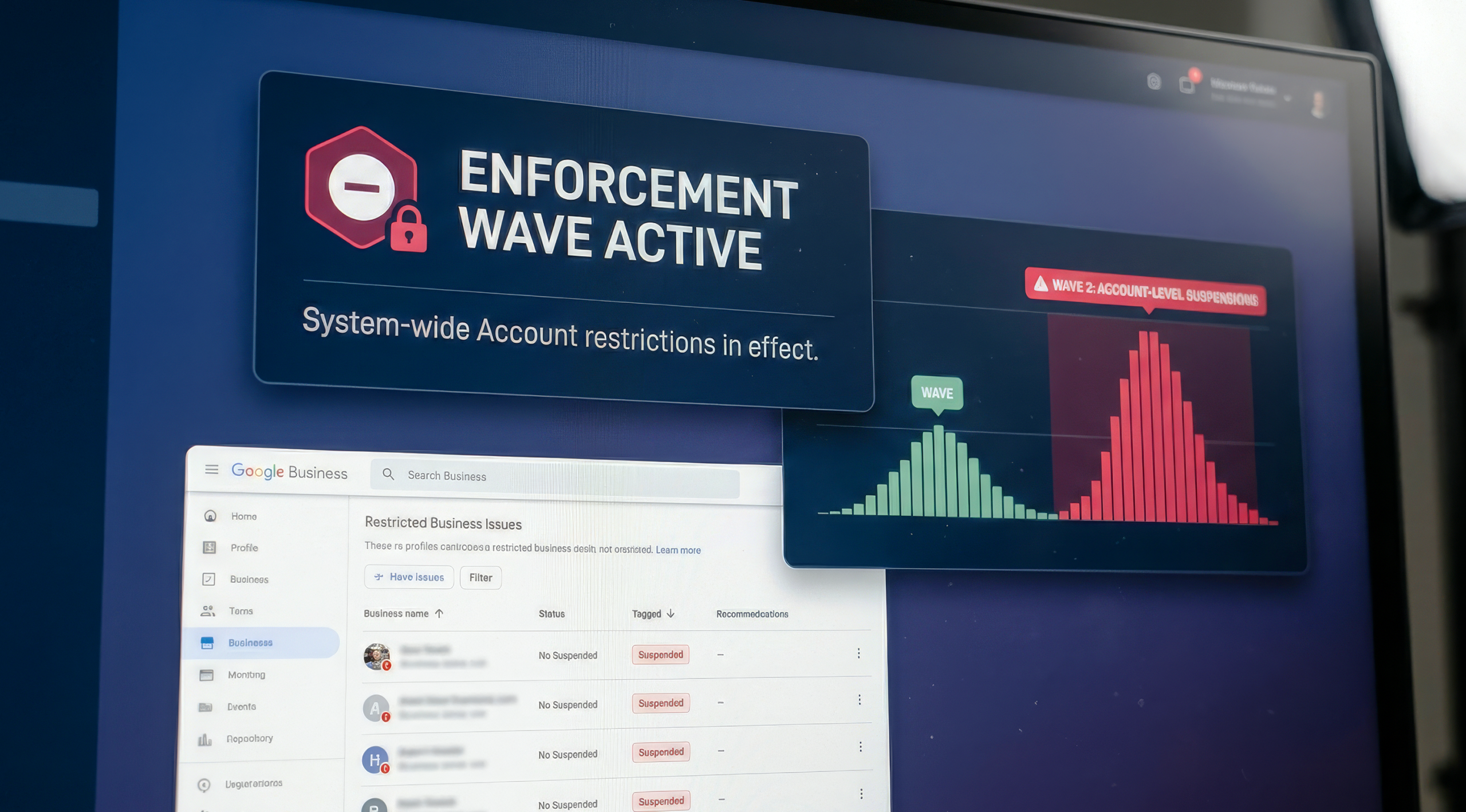
On the night of Sunday, May 3, 2026, Google began restricting entire Google Accounts rather than individual Business Profiles. Every profile under each affected account is suspended simultaneously, account holders cannot create or claim new listings, and the action disproportionately targets accounts running active Local Services Ads or Google Ads. This is the most consequential local search enforcement event since the 2024 verification overhaul, and the pattern signals a permanent shift in how Google moderates local visibility in 2026.
Wave 2 follows an April 27, 2026 enforcement sweep that targeted individual Business Profiles in California home service categories. The May 3 to 4 wave is materially different in scope, severity, and recovery difficulty. Below is what changed, what triggered it, who is exposed, and the steps we are advising our clients to take this week.
What Exactly Happened on May 3 and 4, 2026?
Google began issuing account-level restrictions to Google Accounts that manage one or more Business Profiles. The notification reads: “Your profile has been put under restriction due to policy violation. Business Profiles you manage will be suspended and you won’t be able to create or claim other profiles.”
Three things distinguish this from a normal suspension. First, the restriction is on the Google Account itself, not the Business Profile, which means every profile that account manages is suspended regardless of whether the individual profile is compliant. Second, the account holder is blocked from creating or claiming new profiles, which is unusual outside of repeat-offender enforcement. Third, the routing ID issued with these cases is DPNB, the hardest-to-reverse class in Google’s appeal system.
WHY THIS MATTERS
Multi-location and agency-managed accounts now carry portfolio-level risk.
If every client profile lives under one Google Account, a single algorithmic flag now wipes out the entire portfolio at once. This is the architectural risk Wave 2 has exposed, and it applies equally to multi-location healthcare brands, multi-clinic medspas, and franchise networks managed under a single login.
How Does Wave 2 Differ From the April 27 Wave?
Wave 1 suspended individual Business Profiles in specific California home service categories with the reason “Deceptive Content.” Wave 2 restricts entire Google Accounts with the reason “Policy Violation,” and removes the account holder’s ability to create replacement profiles. The side-by-side comparison below summarises the operational differences.
| Factor | Wave 1 (April 27) | Wave 2 (May 3 to 4) |
|---|---|---|
| Target | Individual Business Profiles | Entire Google Account |
| Reason shown | “Deceptive Content” | “Policy Violation” |
| Scope | 1 to 2 profiles per incident | Every profile under the account |
| Can create new profiles? | Yes | No |
| Routing ID | Various | DPNB |
| Likely trigger | Geographic, category sweep | LSA or Google Ads activity |
| Reversal difficulty | High | Critical, Product Expert needed |
What Is Routing ID DPNB and Why Does It Matter?
DPNB is the Google support routing identifier used for the most contested suspension and restriction cases. Inside Google’s certified Product Expert community, DPNB cases are recognised by three consistent patterns: denied first appeals, broken submission flows where the appeal button fails to render, and resolutions that cannot be reached without direct escalation through a Product Expert with internal access.
For local businesses, this means the standard appeal process, which involves opening the GBP dashboard, clicking “Appeal,” and submitting documentation, has a substantially lower success rate for DPNB-routed cases than for ordinary suspensions. Reinstatement typically requires escalation through Google’s Product Expert channel, which is not a public-facing route. Self-appeals without escalation are usually possible for standard suspensions but rarely successful for DPNB.
Why Is Account-Level Activity Now Triggering Restrictions?
The most consistent pattern emerging from verified Product Expert reports is a connection to Local Services Ads (LSA) or Google Ads activity. Accounts running active LSA campaigns, particularly in home services categories, are being flagged at a rate well above the baseline.
Verified Google Product Expert tracking Wave 2
“We have seen in most cases the account restriction happen due to the LSA or Ads running. No idea why, but that is a common clue.”
This is consistent with a broader 2026 trend. Google has tightened the integration between Google Ads, LSA, and the Business Profile ecosystem. A real or algorithmically perceived violation in any one of those systems can now cascade into the others. The Gemini-powered moderation system Google activated on April 16, 2026 reviews account-level signals across products, not just within the GBP container.
The wider context matters. According to Google’s own transparency reporting, 39.2 million Google Accounts were suspended in 2024, a 3x increase from 12.7 million in 2023. Enforcement is not slowing down. Wave 2 fits that trajectory, and the architecture that enables it is permanent.
WHY THIS MATTERS
GBP, Google Ads, and LSA are now one moderation surface.
If you run Local Services Ads or Google Ads on the same Google Account that manages your Business Profile, your local visibility is structurally coupled to your ad account’s compliance status. A single flag in one system can take down both, along with your downstream AI search visibility on ChatGPT, Perplexity, and Google AI Overviews.
Who Is at Risk in This Wave?
Reports of Wave 2 restrictions are concentrated in three categories so far: home services (garage doors, locksmiths, HVAC, plumbing, landscaping), general contractors and remodelers, and any account running active LSA campaigns. However, the underlying mechanism is account-level moderation that cascades across products, and it is not category-specific. Any local business that fits the profile below carries the same structural exposure.
- Manages multiple Business Profiles from a single Google Account
- Runs Local Services Ads
- Runs Google Ads campaigns alongside its GBP
- Has had prior policy notices on any associated property (YouTube, Workspace, Ads)
- Operates in a high-enforcement vertical: home services, legal, medical aesthetics, addiction treatment, financial services
Garage Door Companies Are at the Center of This Wave
The garage door vertical combines four risk factors Wave 2 is targeting most aggressively: high Local Services Ads spend, multi-location operations frequently managed under shared accounts, elevated Google enforcement focus on home services as a category, and the category-blurring service descriptions (residential, commercial, emergency repair, new install, opener service) that the Gemini moderation system appears to treat as ambiguous.
Logik Digital works with independent garage door dealers, garage door dealers, and multi-location garage door operators across North America. Garage doors is one of our most established verticals, and we have mapped the operational patterns that trigger Wave 2 in this category. If you operate a garage door business, the account architecture work in the next section is not optional. It is the difference between staying visible through the next wave and disappearing from the map.
WHY THIS MATTERS
Garage door operators carry the highest Wave 2 exposure of any local vertical.
Most garage door companies run LSA, manage multiple service-area profiles, and operate the kind of overlapping service categories that Gemini moderation treats as suspect. If your account hits even one cross-product flag, the entire portfolio is at risk. This is not theoretical. It is what we are seeing in inbound cases this week.
Clinics, law firms, medical spas, and chiropractic practices are not the primary target of this wave, but the architecture that enables it applies to every category Google moderates. The risk pattern is universal, and our advice is the same across industries: treat account architecture as a strategic decision, not an operational one.
What Should You Do If Your Account Has Been Restricted?
Do not create a new Google Account to replace the restricted one. Google’s systems will detect the device, IP, and behavioural fingerprints and suspend the new account, often within hours. This is the single most common mistake we see in the days following enforcement waves, and it eliminates the option of a clean reinstatement.
The correct sequence is below. Follow it in order.
- Pause all active LSA and Google Ads campaigns associated with the restricted account before submitting any appeal. The advertising activity may be the active flag, and leaving it running while appealing can extend the case.
- Review your restriction status at myaccount.google.com/restrictions. This is the canonical Google URL for account-level restrictions and the only place where the notice text and routing ID are reliably visible.
- Gather documentation: business license, registration, insurance, utility bill at the business address, business bank statement, and photo evidence of physical operations. PDF format, dated within the last 90 days where possible.
- Audit the account for cross-product exposure. Check Google Ads policy notices, LSA verification status, YouTube channel standing if linked, and any Google Workspace policy events. Wave 2 cases frequently have a precursor flag elsewhere in the account.
- Submit the appeal with a factual, non-emotional explanation. Lead with the documentation, not the narrative. For DPNB routing, request Product Expert escalation explicitly in the appeal text.
- Do not submit duplicate appeals. Multiple parallel appeals can be flagged as spam and meaningfully reduce success rate. One appeal, properly prepared, beats three rushed attempts.
How Do You Protect Your Account Before the Next Wave?
Three things separate accounts that survive enforcement waves from accounts that get caught. None of them are tactical fixes. They are architectural decisions that need to be made before the flag is raised, not after.
1. Account architecture
If you manage multiple Business Profiles, do not consolidate them under one Google Account. Use separate accounts for separate brands, separate locations where business operations are genuinely independent, and separate ad accounts where possible. This limits the blast radius of any single restriction event. The convenience of one login is not worth the portfolio risk it creates.
2. Compliance hygiene across products
Audit your LSA verification documents, Google Ads policy notices, and GBP photo and posts content quarterly. The Gemini moderation system evaluates signals across all three. We cover the foundational discipline in our complete guide to AI SEO for local businesses, which also explains how local entity consistency now feeds AI Overview citation decisions in parallel with traditional ranking signals.
3. Diversified visibility
Businesses that depend on a single Google channel for 60% or more of inbound enquiries are structurally fragile. The strongest local visibility profiles in 2026 combine GBP, organic search, AI Overview citations, and ChatGPT and Perplexity recommendations. Our framework for building this is in our complete AI SEO guide, and the underlying SEO discipline is covered in our SEO for businesses guide.
WHY THIS MATTERS
The era of treating GBP as a self-contained channel is over.
In 2026, GBP, Google Ads, and LSA are one moderation surface, and your AI search visibility on ChatGPT, Perplexity, and Google AI Overviews is downstream of all three. Account architecture is now an AI search strategy decision, not just a local SEO one.
Frequently Asked Questions
Google has not made a public statement. The connection is reported by certified Google Product Experts who handle reinstatements daily and observe the patterns in inbound cases. The correlation is strong and consistent across hundreds of cases, but it is not officially confirmed by Google.
Yes, but DPNB routing ID cases require escalation through a Product Expert in most instances. Standard appeals have a meaningfully lower success rate than for ordinary suspensions. When successful, reinstatement timelines typically run 7 to 21 days.
Pause it, do not delete it. Deletion can be interpreted as evidence-destroying behaviour and may extend the review. Pausing demonstrates good-faith cooperation while the appeal is processed.
The current wave is concentrated in home services, with garage door companies the most heavily affected vertical. Clinics, medspas, and law firms are not the primary target this round, but the underlying enforcement architecture is category-agnostic. Any local business that runs cross-product Google advertising or manages multiple profiles from a single account carries the same structural risk.
Based on the 2024 to 2026 enforcement pattern, individual sweeps run 3 to 7 days, but the underlying moderation system remains active continuously. Treat the current state as the new operating environment, not a temporary event.
Usually not. Because Wave 2 restrictions are issued at the account level rather than the profile level, the trigger is often outside the GBP itself. Common triggers sit in Google Ads, LSA, or another linked product. Cleaning the profile is necessary but rarely sufficient. The full account stack must be audited.
What This Means for Local Visibility Strategy in 2026
The shift from profile-level to account-level enforcement is not a procedural change. It is a strategic signal. Google now treats every local business as a single entity across its products, and moderation decisions in one product cascade across all of them. The implication for local SEO is direct: account hygiene, advertising compliance, and AI search visibility are no longer separate workstreams. They are one workstream with one shared risk profile.
Local businesses that build for this reality, by separating account architecture, diversifying visibility beyond GBP, and structuring content for AI extraction, will compound their resilience through every future wave. Those that don’t will find themselves rebuilding from scratch.
Is your local visibility one Google flag away from disappearing?
If your business runs Local Services Ads or Google Ads on the same account that manages your Business Profile, we recommend an account architecture review before the next wave. Logik Digital can audit your exposure, restructure your account stack, and build the AI search visibility that reduces your dependence on any single Google channel.

Share video
Video URL