



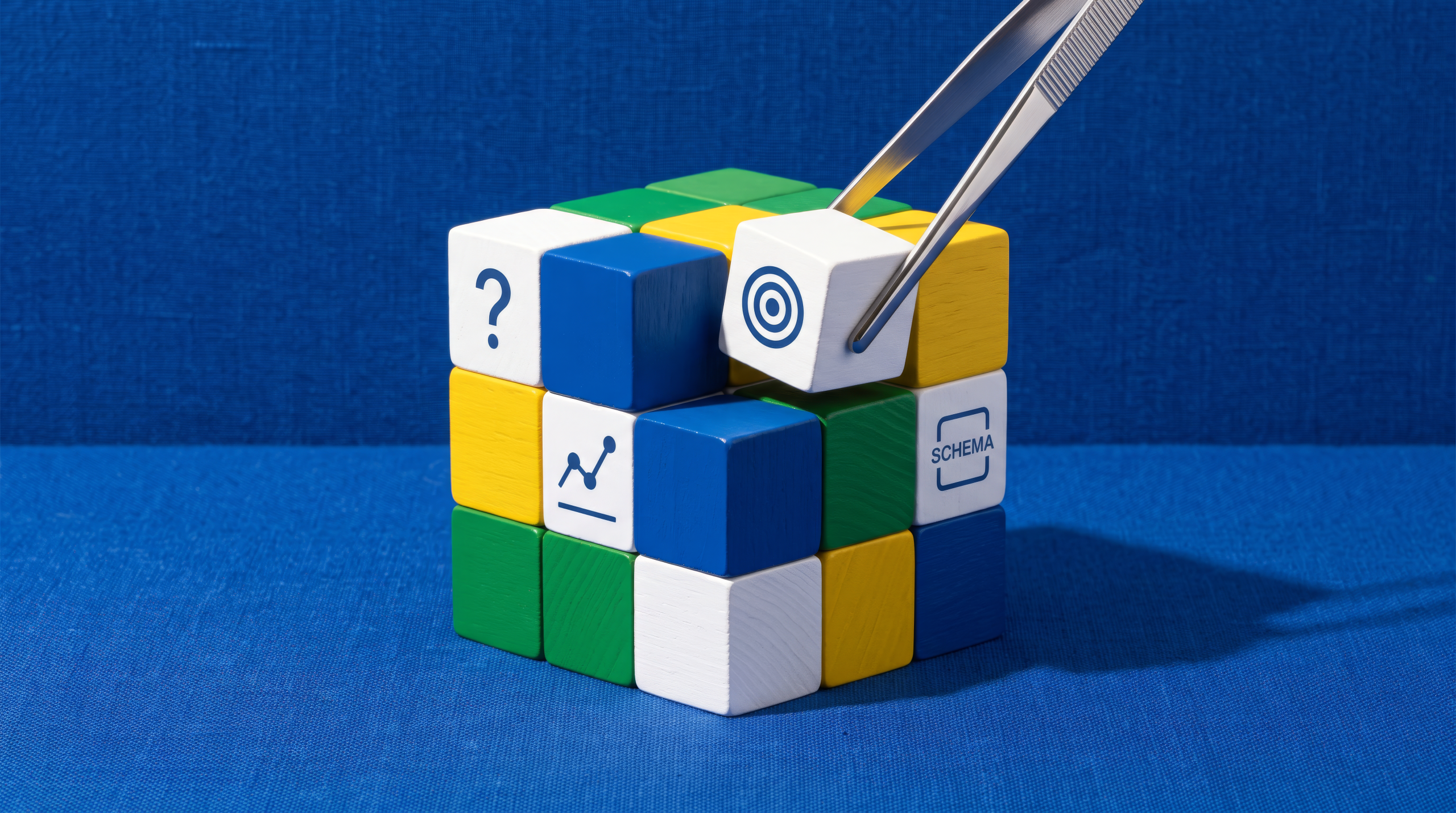
AI search engines extract content at the passage level, not the page level. To get cited by ChatGPT, Google AI Overviews, or Perplexity, structure every section as a self-contained, quotable chunk: open with a direct answer in the first 40 words, include specific data with named sources, and use question-format headings that mirror how users query AI platforms.
This is the single highest-impact optimization most websites are missing. Businesses invest in SEO and earn backlinks – but their content is structured for human readers who scroll, not AI systems that extract. A page with strong rankings can still be invisible to AI if no individual passage is clean enough to pull.
This guide covers the formatting techniques that earn AI citations, with before-and-after examples. For the broader framework, see our complete guide to AI SEO in 2026.
Why AI Engines Extract Passages, Not Pages
AI systems answer queries by finding the single most relevant passage across millions of pages – not by evaluating which page is best overall. This means a well-structured paragraph on a low-authority site can outperform an entire guide on a high-authority domain.
Traditional search engines rank pages based on backlinks, domain authority, and engagement. AI engines work differently – they retrieve candidate passages from across the web, evaluate each independently, then synthesize an answer citing the best sources.
The Princeton GEO research (2023) confirmed this: passage-level optimization increased AI visibility by 30 to 40%. Page-level authority still matters (76% of AI Overview citations come from top-10 pages), but within those pages, structure determines which one gets cited.
The BLUF Format – Bottom Line Up Front
BLUF means placing the direct, complete answer to a question in the first two sentences of a section – before any context, background, or supporting detail. AI engines prioritize opening statements because they scan for the fastest path to a reliable answer.
Most traditional blog content builds to a conclusion – sets context, explores nuances, then delivers the answer. AI extraction works the opposite. The system scans opening statements first.
Before (traditional): “When considering the cost of AI SEO services, it’s important to understand that pricing varies based on several factors, including scope, industry, and competition level. Generally speaking, businesses can expect to invest between $2,000 and $10,000 per month.”
After (BLUF): “AI SEO services typically cost between $2,000 and $10,000 per month, depending on scope, industry, and the number of AI platforms being optimized.”
The after version answers in 18 words. AI engines will extract it. The previous version buries the answer – and may never surface.
How to Write a 40-Word Extractive Answer
Every H2 section should open with a ~40-word passage that completely answers the heading’s question in a single, self-contained statement – this is the exact passage AI engines will evaluate for citation.
The 40-word target is not arbitrary. Passages most frequently cited by ChatGPT and Perplexity fall between 30 and 60 words. Shorter passages lack context to stand alone. Longer passages are harder for AI to evaluate as a single unit.
The formula: state the answer, include one data point, attribute the source. Every extractive answer should make complete sense in isolation.
Weak: “There are several important factors to consider, and the answer depends on your specific situation.”
Strong: “Content updated within 30 days receives 3.2 times more AI citations than older content, according to Amsive research – making monthly refreshes the minimum standard for AI visibility.”
Self-Contained Sections That Work as ‘Information Islands’
Each section of your content should make complete sense if extracted in isolation – no reliance on previous sections for context, no forward references, and no assumptions about what the reader has already seen.
“AI doesn’t read your content like a human – it jumps to the most relevant passage and evaluates it in complete isolation,” explains Kevin Indig, author of the Growth Memo newsletter, whose analysis of 21,000+ ChatGPT citations confirmed that passage-level structure matters more than page-level authority. AI engines do not read content sequentially. They jump to the most relevant section, evaluate it independently, and decide whether to cite it. If that section references “the method described above” or “as we noted earlier,” the passage fails the extraction test.
Every section should include: the topic restated, the direct answer, at least one supporting data point, and a clear attribution. Keep sections to 100 to 150 words. Test with the “isolation read”: cover everything else on the page and read only that section. Does it fully answer the question in the heading? If not, add the missing context.
Question-Format Headings That Mirror AI Queries
H2 headings written as questions earn more AI citations because they directly match the queries users type into ChatGPT, Perplexity, and Google – AI systems pattern-match headings to queries when identifying relevant passages.
A heading that reads “Cost Considerations” is generic. “How Much Does AI SEO Cost?” directly matches what someone types into ChatGPT. When the heading matches the query, AI has higher confidence that the section below contains a relevant answer.
As Mark Williams-Cook, founder of AlsoAsked, notes: “The People Also Ask questions surfaced are the closest in intent proximity – now with AI search and query fan-out, that process is automated.” Use Search Console data, PAA boxes, and AI platform testing to identify exact questions your audience asks. Make those questions your H2S.
Making Statistics and Data Quotable
AI engines cite content with specific, attributed statistics far more frequently than content with vague claims – a passage stating “conversion rates increased 5x (Source: Amsive, 2026)” is dramatically more citable than “conversion rates improved significantly.”
The Princeton GEO research confirmed that adding relevant statistics was one of the highest-impact techniques, increasing AI visibility by 30 to 40%. But the statistic must be quotable – specific, attributed, and self-contained.
Three rules for quotable data: always include the specific number (not “significant”), always name the source (not “studies show”), and always include the year. This gives AI systems a verifiable, attributable claim to cite.
FAQ Sections and Schema as Citation Magnets
FAQ sections with FAQPage schema markup give AI engines pre-structured question-and-answer pairs to extract – pages with FAQ sections average 12% more AI citations because the format eliminates the need for AI to identify extractable passages on its own.
FAQ sections are the lowest-effort, highest-impact structural optimization for AI visibility. Each FAQ is already in the format AI engines need: a clear question followed by a direct answer. When marked up with the FAQ Page schema in JSON-LD, these pairs become machine-readable data that AI crawlers can parse without interpretation.
Keep answers to 3 to 5 sentences with at least one data point. Ensure every FAQ is unique to the page – the FAQPage schema should exist on exactly one page per question.
Before and After – Traditional vs AI-Optimized Content
The same information, structured two different ways, produces dramatically different AI citation outcomes: the before version follows traditional blog conventions, the after version follows AI extraction principles.
Topic: How often should you update content for AI SEO?
Before (traditional): “Content freshness is an important consideration for any SEO Strategy. In the age of AI search, keeping your content up to date matters even more. According to various studies, regularly updating content can positively impact citation rates. Most experts recommend checking content at least once a quarter.”
After (AI-optimized): “Content updated within 30 days receives 3.2 times more AI citations than older content, according to Amsive research. Build a monthly refresh cycle for the highest-priority pages, updating statistics and adding new data. Include a visible ‘Last Updated’ date – AI systems use this signal to assess freshness.”
The previous version: 57 words, zero data, no named source. The after: 49 words, two data points, a named source, and actionable steps. AI engines will cite the latest version.
For the step-by-step process for applying these principles, see our AI SEO guide for 2026. For specific implementation steps, see our guide to AI search optimization.
Frequently Asked Questions
What is a BLUF answer, and why does it matter for AI?
BLUF stands for Bottom Line Up Front – placing the direct answer in the first one to two sentences before any background. AI engines scan opening statements first when evaluating passages. Content that builds to a conclusion is less likely to be extracted and cited.
How long should an extractable passage be?
The most frequently cited passages range from 30 to 60 words. This length provides enough context to stand alone while remaining concise enough for AI to evaluate as a single unit. Each H2 should open with a ~40-word answer that completely addresses the heading’s question.
Do question-format headings really improve AI citations?
Yes. AI systems pattern-match headings to user queries. “How Much Does AI SEO Cost?” directly matches what users type into ChatGPT, giving AI higher confidence that the section below is relevant. Use Search Console data and People Also Ask boxes to identify exact questions.
Should every blog post include an FAQ section for AI?
Yes, for posts targeting queries, AI engines answer. FAQ sections with the FAQ Page schema give AI pre-structured Q&A pairs to extract. Pages with FAQ sections average 12% more AI citations. Keep answers to 3 to 5 sentences with at least one data point each.
How do I make statistics quotable for AI engines?
Three rules: include the specific number (not “significant”), name the source (not “studies show”), and include the year. “AI traffic converts at 5x higher rates (Amsive, 2026)” is quotable. “AI traffic converts much better” is not.
What is the difference between an AI-optimized and a traditional blog structure?
Traditional structure builds context before the answer, uses narrative flow, and assumes sequential reading. AI-optimized structure leads with the answer (BLUF), makes every section self-contained, uses question headings matching queries, and includes attributed data in every passage.
Want your content structured for AI citations? Book a strategy call with Logik Digital – we restructure existing content and create new citation-worthy pages using the exact methodology in this guide.

Share video
Video URL