




Radio-Canada International, the multilingual international service of Canada’s national public broadcaster, featured Hamzah Khadim, co-founder of Toronto-based AI SEO agency Logik Digital, in a report on how the internet is being redesigned for AI rather than human readers. The article, published on August 13th 2026 and syndicated from an original CBC News report by Nora Young, examined what the decline in human web traffic means for businesses and how search has shifted from keywords to conversations.
What the Radio-Canada International feature examined
The article reported on a fundamental change in how the internet works. Human web traffic is declining across major commercial categories while AI bot traffic is rising. Cloudflare data showed declines in human traffic across retail, software, IT, and finance websites, with some of the hardest-hit categories dropping by up to 40 per cent between June 2025 and April 2026.
The article explored what this means for businesses that depend on search visibility, and how the rise of AI summaries and chatbots is changing the relationship between websites and the users who used to visit them. Hamzah Khadim was featured as the practitioner explaining the strategic response: how businesses can adapt their web presence for an era in which machines, not humans, are the primary readers of their content.
Traffic Is No Longer the Metric That Matters
TRAFFIC ISN’T THE WHOLE STORY
“You really need to do the work behind the scenes so that even if you have a decline in traffic, it doesn’t actually result in less business.”
Chasing traffic numbers measures the wrong thing in a search environment increasingly mediated by AI assistants. A drop in visits to your website is no longer a reliable signal of declining business, because a growing share of users never click through.
They get their answer, recommendation, or comparison directly from the assistant, and the “conversion” can happen off-site, in the form of a phone call, a booking, or a walk-in visit prompted by that answer. If your content strategy is still optimized purely to pull people onto your page, you are optimizing for a metric that is becoming decoupled from actual business outcomes.
THE WORK HAPPENS BEHIND THE SCENES
The real work has to happen “behind the scenes,” in the underlying structure and substance of your content, rather than in surface-level tactics designed to inflate click-through rates. It means building pages and sources that give AI systems everything they need to construct a complete, trustworthy answer without a click: explicit credentials, transparent pricing or scope of service, clear geographic coverage, and direct answers to the specific sub-questions a prospective customer is likely to have.
When an assistant can extract a confident, well-supported answer from your content and attribute it to your business, you are still winning the interaction and winning it earlier in the funnel, before a visit is even necessary.
Inside Hamzah’s Conversation with CBC News
CONTENT FOR AI READERS
“People aren’t gonna necessarily read all of that, but AI definitely will,” Khadim said. “And it’ll help establish trust.”
Content written for an audience that will never read it in full may appear to be wasted effort, until one considers how information-seeking behavior has changed. Keyword search functioned as a compressed query: a user entered a few terms and then filtered manually, opening multiple sources and searching for details relevant to their specific circumstances.
This compression no longer occurs when users interact with an AI assistant. They describe their full situation in detail. The system decomposes this input into discrete sub-questions, known as query fan-out, identifies sources capable of answering each one, and synthesizes a recommendation from the results. The practical implication is that ranking for a search phrase and being cited within a generated answer are now distinct outcomes.
For a physiotherapy clinic in Toronto, this means the treatment pages on its website are no longer just for prospective patients browsing the site. They are for ChatGPT, Google AI Overviews, and Perplexity, which read those pages, assess their credibility, and decide whether to recommend the clinic when someone asks for help with a running injury. For a garage door company, the repair guides exist as much for AI retrieval as for homeowners. The content must serve both audiences, but the AI reads it first.
SEO to GEO: What Logik Digital is doing about it
The article noted that “Logik Digital has long specialized in SEO (search engine optimization), so that websites turn up in search results, but it’s now also focused on AI SEO. It means adding specific information that both indicates a site’s credibility and answers the questions a user is likely to ask AI.”
FROM SEO TO AI SEO
The description captures a shift in the agency’s entire service model. SEO earned a position in a list of links. AI SEO earns a place inside an AI’s answer. The techniques overlap, but the objective is different: not ranking, but being cited.
At Logik Digital, AEO & GEO work includes structuring content so AI can extract self-contained answers at the passage level. It includes building entity signals, schema markup, directory consistency, and third-party mentions that let AI verify who a business is before deciding to recommend it. It also monitors AI platforms directly, running the same queries a prospective client would ask across ChatGPT, Google AI Overviews, Perplexity, and Gemini to track whether and how the business appears.
From Missing in AI Overviews to Being Recommended: Inside Logik Digital Work
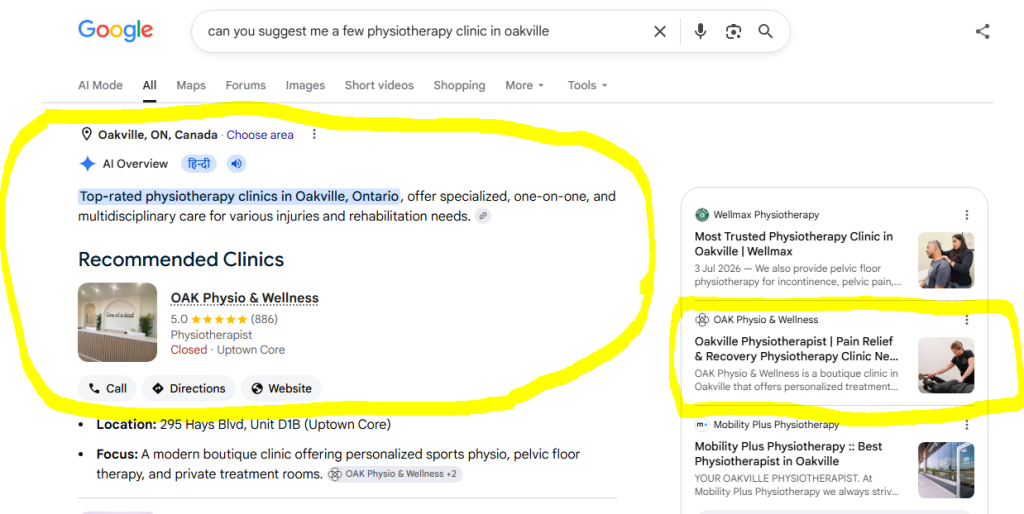
Oak Physio & Wellness was previously not appearing in Google’s AI Overviews for relevant local physiotherapy searches. After working with Logik Digital to strengthen its AI search visibility and digital authority, the clinic began appearing within AI-generated results for relevant queries. This reflects Logik Digital’s approach to AI SEO: helping businesses move beyond traditional search rankings and build the visibility needed to be discovered and recommended in evolving AI-powered search experiences.
What does this mean for your business?
Three things worth doing, drawn directly from what Hamzah discussed with CBC News, can help businesses adapt to the changing search landscape. From strengthening their online presence to creating content that AI systems can understand and trust, these steps can improve how a brand appears across AI-powered search experiences.
- Accept that machines are your first reader: AI now reads every page on your website before it is read by a human. Content structuring for AEO results works for both: clear headings, direct answers in the first sentence of each section, and self-contained passages that make sense when extracted from the surrounding page.
- Move from keywords to conversations: Think about what your prospective clients actually ask, in their own words, when they are trying to solve a problem. Those are the questions AI is answering. Build content that addresses the full conversation, including the follow-up questions, not just the opening search term.
- Build the credibility signals AI checks before recommending you: Your Google Business Profile, your directory listings, your reviews, and your schema markup should all tell the same story. Inconsistency reduces the AI’s confidence, and a machine that is not confident will recommend someone else.
FROM KEYWORDS TO CONVERSATIONS
Think about what your prospective clients actually ask, in their own words, when they are trying to solve a problem. Those are the questions AI is answering. Build content that addresses the full conversation, including the follow-up questions, not just the opening search term.
Read the full Radio-Canada International feature.
Bots now do more of the reading online than people do. The feature covers the drop in human web traffic, what it means for the businesses whose content is now being read by machines, and where Hamzah’s advice fits. Explore the full Radio-Canada International Feature, published on August 13th, 2026.
About Logik Digital
Logik Digital is an AI SEO agency in Toronto, helping local and service-based businesses strengthen their visibility in an increasingly competitive search landscape. The agency works with businesses across industries such as healthcare, legal, and home services, developing search strategies designed for the target audience.
With more than 15 years of experience in search marketing and Google Partner status, Logik Digital combines established SEO expertise with a forward-looking approach to digital visibility. We understand that search behaviour is evolving beyond traditional search engines, with customers increasingly using AI-powered platforms to research businesses, compare options, and make decisions.
Today, Logik Digital focuses on AI SEO, helping businesses build visibility across both Google and emerging AI search platforms. Its approach goes beyond improving traditional rankings by working to ensure clients can be found in relevant searches and cited and referenced by AI platforms.


Share video
Video URL