




Ask ten SEO professionals whether schema markup helps you rank in AI search, and you will get two confident, opposite answers. One camp treats it as essential. The other calls it a waste of time that Google itself has downplayed. Both are partly right, which is exactly why the question causes so much confusion.
The short answer is this: schema markup does not directly make an AI engine cite you. But it makes almost everything else that earns citations work better. It is a part of the complete AI SEO framework in 2026. It is trust infrastructure, not a citation lever, and understanding that distinction is the difference between using it well and either overselling it or dismissing it entirely.
What Schema Markup Actually Is?
Schema markup is a standardised vocabulary of code you add to a page to describe what its content means. Not what it says, what it means. A price becomes a labelled price. A set of opening hours becomes labelled opening hours. A question and answer becomes a labelled question and answer.
Without it, a machine reading your page sees text and has to infer that “$200 to $350” is a price rather than a phone number or a date. With it, you have told the machine directly. In plain terms: schema is how you stop a computer guessing what your content is and start telling it.
What Schema Does and Does Not Do in AI SEO?
Let us be direct about both halves, because the confusion comes from people stating only one.
WHAT SCHEMA DOES NOT DO
Schema does not directly cause an AI engine to cite you. There is no field you can add that flips a switch and makes ChatGPT recommend your business. Google has said repeatedly that structured data is not a ranking factor in the conventional sense, and that guidance carries into AI search.
WHAT SCHEMA DOES
Schema makes your content machine-readable, unambiguous, and easier to trust. It helps a system correctly identify your business as a specific entity, correctly extract your facts, and correctly connect your page to everything else it knows about you. It is the groundwork the actual ranking factors stand on.
Why It Matters More for AI Than It Did for Google?
It breaks your content into small passages and converts each into a form it can match against a question, a process we walked through in how AI search engines find and cite content. Three things schema does are worth spelling out, because each maps to something AI search cares about a great deal.
It establishes your entity
The single most valuable thing schema does for AI is help an engine understand that your business is a specific, real, distinct thing. Entity recognition is foundational to whether an AI will name you at all, and schema is the most direct way to declare it.
It makes your facts extractable
An AI answer is assembled from extracted facts. A price, an opening time, a service area, a question and answer. When those are labelled with schema, the machine lifts them cleanly and correctly. When they are buried in prose, it may extract them wrongly or not at all.
It disambiguates
If three businesses share a similar name, schema is how you help an engine keep yours straight from the others. In a crowded local market, that is not a small thing.
The Schema Types That Matter Most for Local Businesses
You do not need every schema type that exists. A handful carry most of the value for a local or service business, and getting these right matters more than breadth.
| Schema type | What it declares | Why it matters for AI |
|---|---|---|
| LocalBusiness | Name, address, phone, hours, service area | The core of local entity recognition. The foundation everything else sits on. |
| Organization + sameAs | Your identity and links to your profiles elsewhere | Ties your listings into one entity so the AI does not see several weak versions of you. |
| FAQ Page | Questions and their answers | Highly extractable. Put your business name in the answer text, not just the question. |
| Service or Product | What you offer, and where | Lets an engine match your specific services to specific questions. |
| Review / AggregateRating | Ratings and review counts | Reviews act as a trust gate in AI recommendations; labelling them helps them register. |
| Person/Author | Named practitioners and their credentials | Matters most in healthcare and legal, where the credentialled human is part of the trust. |
| BreadcrumbList | Your site structure | Helps an engine understand how your pages relate to one another. |
WHERE TO START
If you are starting from nothing, the order that gives the most return is simple: LocalBusiness first, then Organization with sameAs, then FAQPage on your most important pages. Everything else is refinement.
In Our Work: How Re-juvenation Moved From Featured Snippet to AI Overview
Before AI Overviews reshaped local search, Re-juvenation, a medspa in Georgetown, had already earned the featured snippet for several of its core treatment queries, a strong signal that its content was clear and extractable.
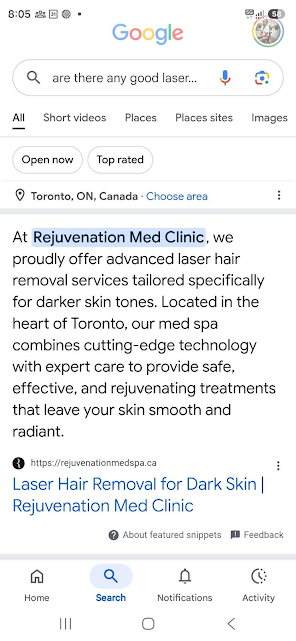
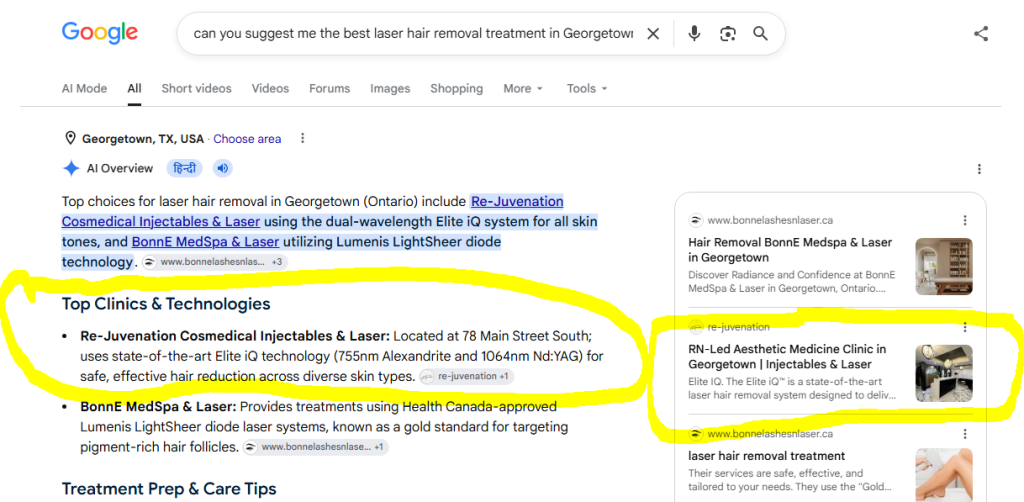
When Overviews arrived, that snippet position did not carry over. As part of a broader rebuild, we tightened the site’s structured data alongside the fact-density, entity-consistency, and review work that makes up the five stages here. Following that update, Re-juvenation began appearing in AI Overviews for treatment-specific searches where it had previously not been cited.
THE LESSON FROM RE-JUVENATION
The schema did not win the citation on its own. What it did was remove ambiguity, so that a page already backed by strong reviews and specific, well-structured content could be read and quoted correctly. These are our own reported client results, and the sequence is the lesson: the foundation came first, and the schema helped the engine see it.
How Schema Connects to the Rest of Your AI Strategy
Schema is not a standalone tactic. Its whole value is in making other work more effective, so it is worth seeing how it links to the pieces around it.
It labels your original research
If you have produced proprietary data, the kind of first-hand information that actually earns citations, schema is how you tell a machine that a given figure is a statistic or a dataset rather than decorative text. The research does the winning; the schema makes sure it is read correctly. We made the case for producing that research in why original research wins AI citations. Without the label, a striking statistic can read to a machine as just another number in a paragraph. With it, the same statistic is flagged as a finding worth extracting, which is exactly what you want when the whole point of the research was to be quoted.
It supports well-structured content; it does not replace it
Schema and on-page structure are partners. Clean headings, direct answers, and self-contained passages are what let an engine extract your content; schema tells it what that content means.
More schema on more pages is not the goal
There is a temptation, once you understand schema, to apply it everywhere at once and treat coverage as the measure of success. That instinct is worth resisting, because schema does not add value to a page that had none to begin with.
Marking up dozens of thin, unoriginal pages does not help. It just labels content that has nothing to offer more clearly, and it spends effort that would be better directed at the pages that actually carry your business facts. At this stage, content pruning for AI works.
QUALITY OVER QUANTITY
More schema is not automatically better schema. Prioritize the pages that contain your most important business facts, services, reviews, practitioners, FAQs, and original research. Marking up thin or inaccurate content simply makes weak information easier for machines to understand.
How to Implement Schema Without Overcomplicating It?
The good news is that this is one of the more approachable technical tasks in SEO. A sensible sequence:
- Start with Local Business: Get your name, address, phone, hours, and service area labelled correctly and consistently with how they appear everywhere else online.
- Add Organization with sameAs: List the URLs of your profiles on Google, the major directories, and your social platforms. This is the single highest-value entity signal you can send.
- Add FAQPage to key pages: Use real questions your customers ask, and put your business name inside the answer text rather than only in the question.
- Validate everything: Run every page through Google’s Rich Results Test and the Schema.org validator. Broken or invalid schema can do more harm than none at all.
- Keep it consistent and current: Your schema must match what is visible on the page and match your details elsewhere. Inconsistent markup fragments your entity instead of strengthening it.
THE FIVE-STEP SCHEMA CHECK
The practical rule is simple: identify the entity, define the important facts, connect the entity to trusted external profiles, validate the markup, and keep everything consistent with the visible page and your other listings.
What This Means for a Local Business
Pulling it together for the businesses we work with most- clinics, firms, and contractors- the position is encouraging. Schema is one of the few AI-readiness tasks that is genuinely within reach, does not depend on producing content, and pays off across every engine at once. It is the plumbing that lets your reviews, your service pages, and your profile register correctly.
So, if you’re doing AI SEO for local business, then implementing Schema markup fits the broader local picture. For a local business, that makes it one of the highest-return, lowest-drama investments in AI readiness. Not glamorous. Just foundational, and far easier to get right than most of the work built on top of it.
Frequently Asked Questions
Want Your Schema Audited Properly?
Most local businesses have schema that is incomplete, inconsistent with their other listings, or quietly broken. Logik Digital audits and implements structured data as part of AI readiness, so your entity, facts, and reviews register correctly across every engine.

Share video
Video URL