CBC News spoke to Hamzah Khadim, co-founder of the Toronto-based AI-SEO agency Logik Digital, about how AI summaries and chatbots are changing the way people find information online. The feature ran on CBC News as a written analysis by technology reporter Nora Young and as a segment on The National. It examined a change that is already measurable rather than speculative: human traffic to websites is falling, and machines now do a large share of the reading. What the CBC Feature Examined The piece set out to answer a question that most business owners have not yet asked. If an AI tool answers the question directly, what happens to the website that used to supply the answer? The data behind that question is not ambiguous. Cloudflare, which provides internet infrastructure for a large share of the web, measured traffic between June 2025 and April 2026 and found human visits declining […]
Ask ten SEO professionals whether schema markup helps you rank in AI search, and you will get two confident, opposite answers. One camp treats it as essential. The other calls it a waste of time that Google itself has downplayed. Both are partly right, which is exactly why the question causes so much confusion. The short answer is this: schema markup does not directly make an AI engine cite you. But it makes almost everything else that earns citations work better. It is a part of the complete AI SEO framework in 2026. It is trust infrastructure, not a citation lever, and understanding that distinction is the difference between using it well and either overselling it or dismissing it entirely. What Schema Markup Actually Is? Schema markup is a standardised vocabulary of code you add to a page to describe what its content means. Not what it says, what it […]
Query fan-out is the technique AI search engines use to break one prompt into 8 to 12 parallel sub-queries behind the scenes, retrieve passages for each, and merge the results into a single cited answer. Google AI Mode averages 10.7 sub-queries per prompt, ChatGPT generates 2 to 4, and Perplexity uses a single query 70% of the time. This guide explains what fan-out is, how it works across platforms, the latest research on its impact on citations, and what it means for businesses trying to earn AI visibility. What Is Query Fan-Out and Why Does AI Search Use It? AI search engines do not run one search per prompt. They decompose the prompt into several sub-queries, run them in parallel, retrieve passages for each, and fuse them into a single synthesized answer. Google patent language calls this query variant generation. Traditional search matches your words against an index and returns […]
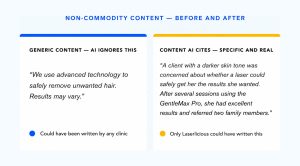
BOTTOM LINE UP FRONT AI search engines do not reward volume. They reward specificity. A generic service page that describes what you do in broad terms will be skipped over entirely in favour of a page that describes exactly who you helped, with what treatment, and what the outcome was. In 2026, the content that earns AI citations is content that no competitor could have written, because it came from your experience, not a keyword tool. In April 2026, Google’s Danny Sullivan stood in front of an audience in Toronto at Google Search Central Live and said something that should have landed differently than it did. He told creators that commodity content is losing ground fastest as AI becomes the first stop in the search journey. Most people in the room nodded and moved on. The implication was enormous. If AI can write a decent summary of what you offer, […]
Google’s AI-generated search summaries appear at the top of results for over 25% of queries, synthesizing answers from multiple web sources and citing 2 to 7 domains per response. They select sources based on five factors: content relevance to the query, web consensus (corroboration across sources), structured data and schema markup, content freshness, and domain authority as reflected in organic rankings. These AI summaries have fundamentally changed the economics of Google search. When they appear, organic click-through rates drop 61% according to Seer Interactive. But being cited inside an AI Overview increases your organic CTR by 35% and paid CTR by 91%. The visibility is worth more than ever – there are just fewer seats at the table. This guide explains how AI Overviews select sources, how they differ from AI Mode and featured snippets, what triggers them, and how to optimize your content for inclusion. For the full AI […]
Local businesses can earn AI citations by optimizing four things: Google Business Profile data (which feeds directly into Google AI Overviews), local schema markup (LocalBusiness, GeoCoordinates, Service types), NAP consistency across directories, and location-specific content that AI engines can extract when answering “near me” and city-specific queries. Most AI SEO content is written for enterprise SaaS companies and national brands. Local service businesses – clinics, law firms, contractors, medspas – are dramatically underserved by existing guidance. Yet local businesses have a unique advantage: the competition for local AI citations is a fraction of what it is nationally, and AI engines are increasingly surfacing specific local recommendations. At Logik Digital, local businesses are our core clientele. We work with physiotherapy clinics, counselling centres, medical spas, law firms, and home service companies across North America. This guide covers what we have learned about AI search visibility specifically for businesses that serve customers […]








Share video
Video URL