Local businesses can earn AI citations by optimizing four things: Google Business Profile data (which feeds directly into Google AI Overviews), local schema markup (LocalBusiness, GeoCoordinates, Service types), NAP consistency across directories, and location-specific content that AI engines can extract when answering “near me” and city-specific queries. Most AI SEO content is written for enterprise SaaS companies and national brands. Local service businesses – clinics, law firms, contractors, medspas – are dramatically underserved by existing guidance. Yet local businesses have a unique advantage: the competition for local AI citations is a fraction of what it is nationally, and AI engines are increasingly surfacing specific local recommendations. At Logik Digital, local businesses are our core clientele. We work with physiotherapy clinics, counselling centres, medical spas, law firms, and home service companies across North America. This guide covers what we have learned about AI search visibility specifically for businesses that serve customers […]
AI search engines extract content at the passage level, not the page level. To get cited by ChatGPT, Google AI Overviews, or Perplexity, structure every section as a self-contained, quotable chunk: open with a direct answer in the first 40 words, include specific data with named sources, and use question-format headings that mirror how users query AI platforms. This is the single highest-impact optimization most websites are missing. Businesses invest in SEO and earn backlinks – but their content is structured for human readers who scroll, not AI systems that extract. A page with strong rankings can still be invisible to AI if no individual passage is clean enough to pull. This guide covers the formatting techniques that earn AI citations, with before-and-after examples. For the broader framework, see our complete guide to AI SEO in 2026. Why AI Engines Extract Passages, Not Pages AI systems answer queries by finding […]
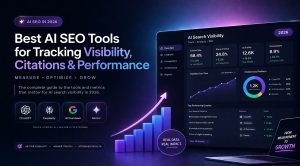
The best AI search visibility tools in 2026 fall into four categories: citation tracking (monitoring where your brand appears in AI answers), content optimization (structuring content for AI extraction), technical AI SEO (schema validation, crawler access auditing), and performance monitoring (measuring AI-referred traffic and conversions). The right stack depends on whether you need enterprise-scale automation or are starting with manual workflows. AI search visibility cannot be measured solely with traditional SEO tools. Google Search Console does not report on AI Overview inclusion. Google Analytics does not natively separate AI-generated traffic from organic traffic. And no single platform tracks citations across ChatGPT, Perplexity, Google AI Overviews, and Gemini simultaneously with complete accuracy. Building an effective measurement stack requires combining purpose-built AI visibility tools with manual testing. This guide covers the KPIs you should track, the tools available in each category, free alternatives, and the measurement framework we use at Logik Digital […]
AI search engines find content through web crawling and index retrieval, then decide what to cite using two key systems: a confidence engine that checks whether information has consensus across the web, and a linkifying engine that matches verified passages to specific source URLs. Understanding this process is the difference between content that gets cited and content that gets ignored. Every AI platform – ChatGPT, Google AI Overviews, Perplexity, Gemini – follows a variation of this retrieve-evaluate-cite pipeline. The specifics differ by platform, but the core mechanics are consistent. For the broader AI SEO framework, see our comprehensive AI SEO strategy guide. How ChatGPT Finds and Cites Content ChatGPT’s search feature appears heavily dependent on Google’s organic index, meaning your Google rankings directly influence whether ChatGPT cites you – making traditional SEO a prerequisite for ChatGPT visibility. ChatGPT operates in two modes. Its base model draws from training data with […]
Optimizing your website for AI search engines requires five core actions: audit your current AI visibility, restructure content for passage-level extraction, implement schema markup, configure access for AI crawlers, and build a quarterly content refresh cycle. These steps apply whether you are targeting ChatGPT, Google AI Overviews, Perplexity, or all three simultaneously. Most businesses have invested years in traditional SEO but have never checked whether AI engines can actually extract and cite their content. AI systems do not rank pages – they retrieve passages. A website that ranks well in Google can still be invisible to ChatGPT if its content lacks clear, extractable answers. This guide walks through each AI Optimization step in priority order, from quick wins you can implement this week to long-term investments that compound over time. For the full strategic framework, see our full AI SEO guide for 2026. What Do AI Search Engines Look For […]
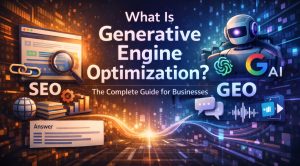
Generative Engine Optimization (GEO) is the practice of optimizing your digital content so that AI-powered search platforms – ChatGPT, Google AI Overviews, Perplexity, Gemini, and Copilot – can retrieve, understand, and cite your business when generating answers to user queries. Unlike traditional SEO, which focuses on ranking pages in search results, GEO focuses on earning citations within the AI-generated answer itself. The discipline has moved from academic theory to operational reality in under three years. ChatGPT now reaches 900 million weekly active users. Google AI Overviews appear in over 25% of all searches. For businesses, the question is no longer whether AI search matters – it is whether your content is structured to earn visibility in it. This guide covers the origins of Generative Engine Optimization, how it differs from SEO, which platforms it applies to, and why businesses of every size can benefit. For the broader AI SEO framework, […]






Share video
Video URL