



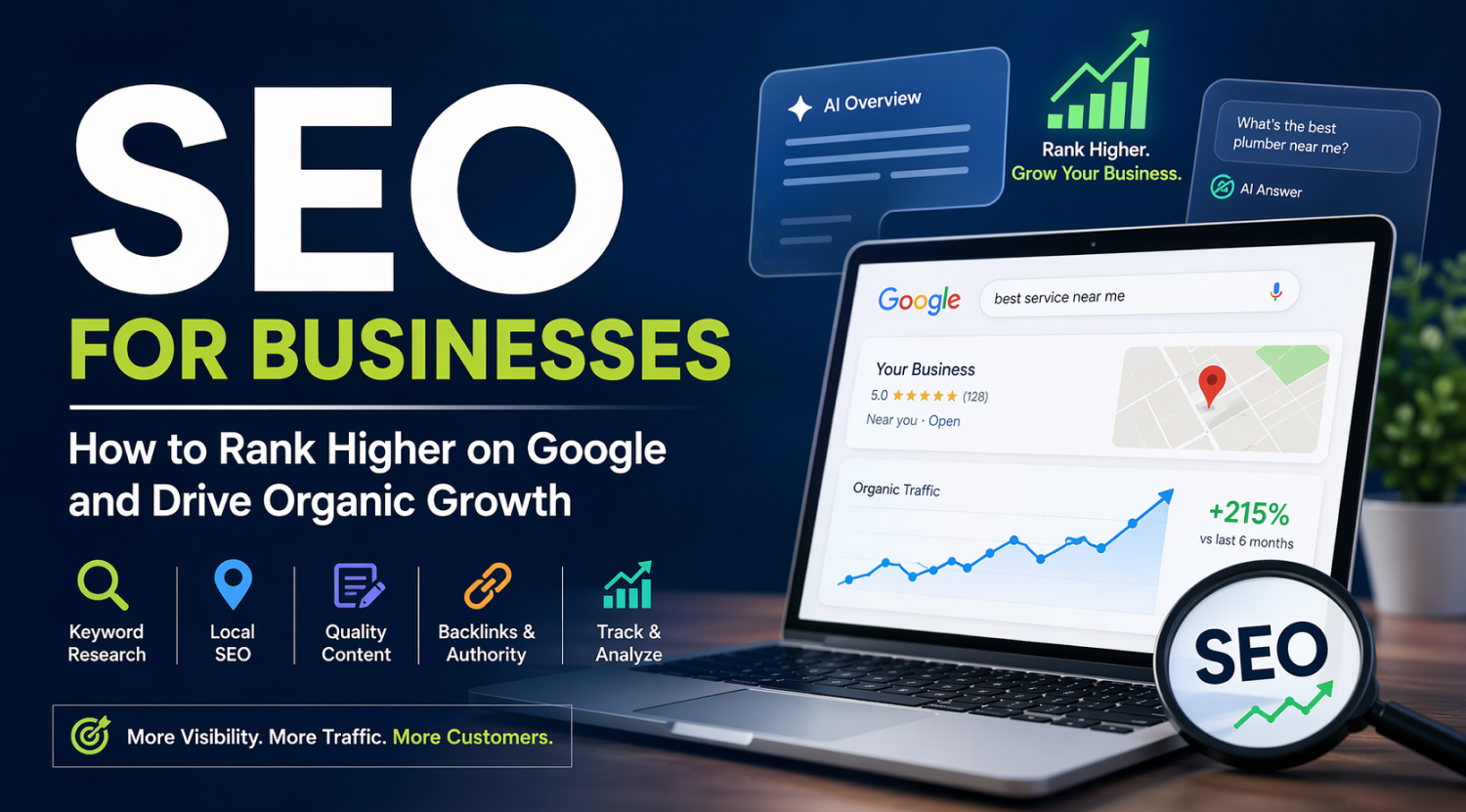
When someone searches Google for a service or product you offer, your business either shows up – or it doesn’t. SEO (Search Engine Optimization) is what determines which side of that divide you land on. According to BrightEdge, 53% of all website traffic comes from organic search. For most businesses, Google remains the single largest source of potential customers.
But search has evolved. In 2026, Google’s AI Overviews appear in over 25% of searches, ChatGPT processes 900 million weekly queries, and Perplexity handles over 500 million monthly. Ranking on page one still matters – but so does being the source AI engines cite when generating answers. The businesses that combine strong traditional SEO with AI-ready content structure are the ones capturing traffic from both channels.
At Logik Digital, we have spent 15+ years building SEO strategies for local service businesses across healthcare, legal, home services, and e-commerce. This guide covers SEO from the ground up: what it is, how to research keywords, how to optimize your pages, how to win in local search, how to create content that ranks in both Google and AI search, how to analyze competitors, and how to measure results. Whether you are starting from scratch or improving an existing foundation, every section tells you what to do and why it matters.
Why SEO Matters for Your Business
What SEO Actually Is
SEO is the process of improving your website so that it appears higher in search engine results when people search for terms related to your business. When someone types “emergency plumber near me” or “best family lawyer in Toronto” into Google, the results they see are determined by Google’s algorithm – a system that evaluates hundreds of factors to decide which websites deserve to rank at the top.
In 2026, SEO has expanded beyond traditional rankings. Google now uses AI to generate synthesized answers at the top of many search results, pulling from the same content that ranks organically. A February 2026 study by Lily Ray at Amsive Digital found that 100% of sites that lost organic visibility also lost AI citations, meaning that traditional SEO and AI visibility rise and fall together. For a complete breakdown of how AI search works and how to optimize for it, see our AI SEO guide covering GEO, AEO, and citation strategies.
SEO vs. Paid Advertising
| Factor | SEO (Organic Search) | Paid Ads (Google Ads) |
|---|---|---|
| Cost | Time investment upfront; free clicks once ranking | Pay per click; costs stop when the budget stops |
| Timeline | 3–6 months to see meaningful results | Immediate traffic once campaigns launch |
| Trust | Organic results are trusted more by searchers | Some users skip ads; lower trust signal |
| Longevity | Rankings can last months or years with maintenance | Traffic disappears when you stop paying |
| Click-through rate | ~27% for position 1 organic result | ~2–5% for paid ads on average |
| AI visibility | Ranked content also gets cited by AI engines | No AI citation benefit from paid ads |
| Best for | Long-term, compounding traffic growth | Immediate visibility and testing |
The two approaches work best together. Google Ads gives you immediate visibility while SEO builds long-term organic traffic. Over time, strong organic rankings reduce your dependence on paid ads – and they also feed AI citation visibility, which paid ads cannot provide.
The Long-Term Value of SEO
SEO compounds. A blog post you publish today can rank for years and drive traffic every single day without additional cost. A service page that ranks #1 for a high-intent keyword generates leads month after month. Unlike paid advertising – where traffic stops the moment your budget runs out – SEO builds an asset that appreciates over time.
According to Ahrefs (2024), the average #1 ranking page also ranks in the top 10 for nearly 1,000 other related keywords. That means one well-optimized page can capture traffic from hundreds of different searches – far more than the single keyword you originally targeted.
“The shift from publishing random blog posts to building structured topic clusters around core services is consistently the single biggest factor in ranking improvements for local businesses,” says Lily Ray, VP of SEO at Amsive Digital, whose research on AI citation patterns has demonstrated the direct link between organic authority and AI visibility.
Keyword Research: Finding What Your Customers Search For
Keywords are the words and phrases people type into search engines. Keyword research is the process of figuring out which terms are most valuable for your business – the ones real potential customers are searching for, that you can realistically rank for, and that lead to conversions.
Understanding Search Intent
Not all searches are the same. Someone searching “what is a dental implant” is researching. Someone searching “dental implant cost in Mississauga” is comparing. Someone searching “book dental implant consultation” is ready to act.
| Intent Type | What the Searcher Wants | Example Keywords | Best Content Type |
|---|---|---|---|
| Informational | Learn or understand something | “What causes back pain?” “How does SEO work?” | Blog post, guide, FAQ |
| Commercial | Compare options before deciding | “best plumber in Toronto,” “CRM software comparison.” | Comparison page, review, list |
| Transactional | Take a specific action now | “book dentist appointment,” “buy running shoes online.” | Service page, product page, landing page |
| Local | Find a nearby business or service | “lawyer near me,” “pizza delivery Oakville.” | Location page, GBP listing |
In 2026, a growing category of queries flows through AI engines. These tend to be longer, more conversational, and more specific – “What should I look for when hiring a personal injury lawyer in Toronto?” rather than “personal injury lawyer Toronto.” AI-powered keyword research tools like Ahrefs, Semrush, and Google’s own autocomplete can surface these conversational queries alongside traditional short-tail keywords.
Long-Tail vs. Short-Tail Keywords
Short-tail keywords (“plumber,” “lawyer,” “dentist”) have high search volume but are extremely competitive and vague. Long-tail keywords (“emergency plumber for burst pipe in Mississauga,” “personal injury lawyer free consultation Toronto”) have lower volume but much higher intent – and they are far easier to rank for.
For most small and medium businesses, long-tail keywords are where the real opportunity lies. They attract visitors who are further along in the buying journey. A page that ranks #1 for “how much does a kitchen renovation cost in the GTA” drives more valuable traffic than one fighting for position 30 on “kitchen renovation.”
Long-tail keywords also align with how people query AI search engines. ChatGPT and Perplexity users tend to ask full questions rather than type short keyword fragments, making long-tail optimization a strategy that serves both traditional search and AI visibility simultaneously.
Where to Use Keywords on Your Website
Once you have identified your target keywords, place them naturally in: page titles (the most important placement), H1 headings, meta descriptions, the first 100 words of body content, H2 and H3 headings where relevant, image alt text, and URL slugs. The emphasis is on “naturally” – if a sentence reads awkwardly because you forced a keyword in, rewrite it. Google’s AI-powered algorithms understand synonyms, related terms, and natural language. Keyword stuffing will hurt your rankings, not help them.
Local SEO and Google Business Profile
If your business serves a specific geographic area, local SEO is where you will see the fastest and most tangible results. Google’s data shows that 76% of people who search for something nearby on their phone visit a business within 24 hours, and 28% of those searches result in a purchase.
What Local SEO Includes
Local SEO combines your Google Business Profile (which controls your visibility in the map pack), your website’s local relevance (location pages, local keywords, NAP consistency), and external signals like reviews, citations, and local backlinks. Our dedicated GBP optimization guide covers profile setup, reviews, posts, and analytics in detail.
In 2026, local SEO has an additional dimension: Google Business Profile data now feeds directly into AI Overviews. When someone asks an AI engine, “What’s the best physiotherapist near me?”, the response increasingly draws from GBP listings, reviews, and structured business data. Optimizing your GBP is no longer just about the map pack – it is about AI visibility for local queries.
NAP Consistency
NAP stands for Name, Address, and Phone number. These three pieces of information must be identical everywhere they appear online: your website, your Google Business Profile, Facebook, Yelp, industry directories, and every other listing. Even minor inconsistencies (“St.” vs. “Street,” different phone formats) weaken Google’s confidence in your business information and hurt both local rankings and AI citation likelihood.
“AI systems must first understand your entity, then trust it, before they can recommend it,” says Jason Barnard, CEO of Kalicube and a leading entity SEO strategist. “Businesses with clearly defined, consistent information across knowledge bases earn significantly more AI recommendations.”
Local Citations and Directory Listings
Citations are mentions of your business name, address, and phone number on other websites. According to Whitespark’s Local Search Ranking Factors, citation signals account for approximately 7% of local pack ranking factors. Quality and consistency matter more than quantity. Audit your citations using tools like Moz Local or BrightLocal to identify and fix inconsistencies.
Reviews and Local SEO
Review signals account for roughly 20% of local ranking weight. Both the number of reviews and the actual words inside them matter – Google’s AI reads review text for keywords and context. A steady stream of recent, detailed reviews sends a stronger signal than a batch of old reviews with no recent activity. Research indicates that businesses with strong review profiles are 3 times more likely to be cited in ChatGPT. Our email marketing guide covers how to automate review requests through post-service follow-up sequences.
Geo-Specific Content
Create content specific to the areas you serve. Location pages (one for each city or neighbourhood you target), blog posts that reference local landmarks, events, or regulations, and service pages that mention your geographic area all send strong local relevance signals. A page titled “Emergency Plumbing Services in Mississauga” will rank for local searches that “Emergency Plumbing Services” alone never will. This locally-specific content also gives AI engines the data they need to confidently recommend your business for location-based queries.
On-Page SEO: Optimizing Your Website’s Content
On-page SEO refers to the things you can control directly on your website – your content, page structure, titles, and internal linking. These are the foundational elements that tell Google what each page is about.
Page Titles and Meta Descriptions
Your page title is the single most important on-page element. It should include your primary keyword, be under 60 characters, and be compelling enough to earn a click. Your meta description (the 2-line summary beneath the title) doesn’t directly affect rankings, but it heavily influences click-through rate. Write it as a clear, benefit-driven summary under 160 characters.
Internal Linking
Internal links serve two purposes: they help visitors navigate to related content, and they help Google understand the structure and hierarchy of your site. Every page should link to other relevant pages using descriptive anchor text. A strong internal linking structure distributes ranking authority across your site and helps Google discover all your pages. Orphan pages – pages with no internal links pointing to them – are effectively invisible to both visitors and search engines.
At Logik Digital, we build internal linking architectures using a topic-cluster model: a comprehensive pillar post surrounded by focused supporting posts, all interlinked. This structure signals topical authority to both Google’s traditional algorithm and AI retrieval systems.
Content Optimization
Each page should target one primary keyword and a handful of related terms. Write comprehensive content that fully answers the searcher’s question – thin content that only scratches the surface will be lost to competitors who go deeper. Structure your content with clear headings, short paragraphs, and self-contained sections that can function as standalone extractable passages. This structure serves both human readers and AI systems that evaluate content at the passage level. Our website design guide covers how to structure service pages to drive conversions and improve search visibility.
Image Optimization
Every image should have descriptive alt text. Use your target keyword in alt text where it naturally fits, but describe the actual image. Compress images to reduce file size without losing quality – tools like TinyPNG or ShortPixel handle this automatically. Large, uncompressed images are among the most common causes of slow page load times.
Off-Page SEO: Building Authority Beyond Your Website
Off-page SEO refers to signals from outside your website – primarily backlinks, brand mentions, and social signals. These tell Google that other sources consider your website trustworthy and authoritative.
Backlinks: Quality Over Quantity
Backlinks remain one of the strongest ranking factors. A 2024 Ahrefs study found a strong correlation between referring domains and organic traffic. One link from a respected local news site or industry publication is worth more than 100 links from low-quality directories.
For local businesses, the most accessible backlink sources include: local business associations and chambers of commerce, industry-specific directories, supplier and partner websites, local sponsorships and community involvement, and guest articles on local news sites.
Brand Mentions and Online Reputation
Google increasingly uses brand mentions – instances where your business is referenced online, even without a direct link – as an authority signal. A 2024 Ahrefs study of 75,000 brands found that branded web mentions correlate more strongly with AI visibility (r = 0.664–0.71) than traditional backlink metrics. This means getting mentioned in local media, industry publications, and community platforms builds authority for both Google rankings and AI citations.
Managing your online reputation – responding to reviews, maintaining consistent information, staying active on social media – supports both your backlink profile and your AI entity signals.
Technical SEO: Making Sure Google Can Find and Read Your Site
Technical SEO is the behind-the-scenes infrastructure that makes your content accessible to search engines. You can have the best content in the world, but if Google – and AI crawlers – can’t properly access your pages, none of it matters.
Site Speed
Page speed is a confirmed Google ranking factor. Google’s research shows 53% of mobile visitors abandon a page that takes more than 3 seconds to load. Fast-loading pages also earn 3 times as many AI citations, according to GEO research. Test your site with Google PageSpeed Insights and prioritize image compression, code minification, caching, and hosting quality.
Mobile Optimization
Google uses mobile-first indexing, meaning it evaluates the mobile version of your website to determine rankings. If your site isn’t responsive, you are at a significant disadvantage. Test on multiple devices: text should be readable without zooming, buttons should be tappable, and no content should be hidden or broken on mobile.
AI Crawler Access
In 2026, search visibility extends beyond Googlebot. AI platforms like ChatGPT (GPTBot), Claude (ClaudeBot), and Perplexity (PerplexityBot) use their own crawlers to access your content. Review your robots.txt file and firewall settings to ensure these crawlers can reach your pages. Blocking AI crawlers means blocking AI visibility – a growing share of how customers discover businesses.
Schema Markup
Schema markup is structured code that helps search engines and AI systems understand the context of your content. For businesses, the most important types are: LocalBusiness schema (your name, address, phone, hours), FAQ schema (turns FAQ sections into expandable results and feeds AI extraction), Article schema (for blog posts), and HowTo schema (for step-by-step content). Schema earns rich snippets in Google and makes your content significantly more extractable by AI engines.
SSL and Security
HTTPS (the padlock in the browser bar) is a confirmed ranking signal. Most hosting providers include free SSL certificates – there is no reason not to have one in 2026.
Content Marketing for SEO
Content is the engine of SEO. Without it, you have nothing to rank. The goal is to create content that answers the questions your potential customers are actually searching for – better, more thoroughly, and more helpfully than anything else currently ranking.
Creating Content That Ranks and Converts
The content that performs best has three qualities: it is comprehensive (covers the topic thoroughly), specific (answers a real question with concrete detail), and structured (uses clear headings, short paragraphs, and scannable formatting). A 2,000-word guide that thoroughly answers “How much does a kitchen renovation cost?” with specific price ranges, factors that affect cost, and a comparison table will outrank a 300-word blog post that vaguely discusses renovation budgets.
“Content with specific statistics earns significantly more AI visibility – our research showed a 30 to 40% improvement when content included cited data points, expert quotations, and structured formatting,” note the authors of the Princeton GEO research paper, the first academic study on content optimization for AI search engines.
In 2026, content structure matters as much as content quality. AI engines extract passages, not pages – so every section should open with a direct answer, include specific data, and function as a standalone, quotable unit. This structure serves both Google rankings and AI citation likelihood.
Blog Topics That Drive Traffic
The best blog topics come from your customers – the questions they ask before buying, the concerns they raise during consultations, the comparisons they make between options. “How much does X cost in [city]?” “What’s the difference between X and Y?” “How long does X take?” Each one can become a blog post that ranks and drives traffic from both traditional search and AI engines.
Promote your blog content via email marketing and social media to drive initial traffic and engagement. Over time, well-optimized posts earn traffic organically through search.
Updating and Refreshing Existing Content
SEO isn’t just about creating new content – it’s about maintaining what you have. Pages with outdated information lose rankings over time. Review your top-performing content every 6–12 months: update facts and figures, add new sections, and refresh the “Last Updated” date. Content updated within 30 days receives 3.2 times more AI citations, according to research by Amsive, making regular refreshes critical for both traditional SEO and AI visibility.
Competitor Analysis: Learning from What’s Already Ranking
You don’t have to start from scratch. The businesses currently ranking for your target keywords have already shown you what Google considers relevant. Your job is to understand what they are doing, identify what they are missing, and create something better.
| Element | What to Look For | What It Tells You |
|---|---|---|
| Content depth | Word count, subtopics covered, data included | The minimum depth needed to compete |
| Page structure | Headings, FAQs, tables, internal links | What Google considers “complete” for this topic |
| Local specificity | Location references, local pricing, local data | Usually, a gap – most content is generic |
| Content freshness | Publish date, last updated date | Stale content is beatable with a fresh page |
| Backlink profile | Number and quality of sites linking to them | How much off-page authority do you need |
| Schema markup | FAQ schema, article schema, local schema | Quick technical wins if competitors lack it |
| AI citation status | Whether AI engines cite their content | The emerging competitive dimension |
Use AI-powered tools like Ahrefs or Semrush to analyze who ranks for your target keywords. Read their content carefully. Note what they cover well – and more importantly, what they miss. Every gap is an opportunity to create something more useful, more local, more current, or more comprehensive.
Tracking and Measuring SEO Performance
SEO without measurement is guessing. You need to know which pages drive traffic, which keywords you rank for, and whether that traffic is turning into business results.
Essential Tools
| Tool | What It Does | Key Things to Monitor |
|---|---|---|
| Google Search Console | Shows how Google sees your site | Impressions, clicks, average position, crawl errors |
| Google Analytics 4 | Tracks visitor behaviour on your site | Traffic sources, page views, conversions, and AI referral traffic |
| Google Business Profile Insights | Shows how people interact with your GBP | Search views, calls, direction requests, website clicks |
| AI visibility monitoring | Tracks your presence in AI-generated answers | Citation rate, mention rate across ChatGPT, Perplexity, AI Overviews |
Key Metrics to Watch
Organic traffic is your primary indicator of SEO health. Watch it monthly – you are looking for a consistent upward trend over quarters. Keyword rankings tell you which pages are gaining or losing visibility. Click-through rate tells you whether your titles are compelling. Conversion rate from organic traffic tells you whether visitors are becoming customers.
In 2026, add AI visibility to your measurement framework. Track whether your content appears in AI-generated answers for your target queries. AI-referred traffic converts at 5 to 23 times the rate of standard organic traffic, making it the highest-value discovery channel available.
Setting Realistic Timelines
Most businesses should expect 3–6 months before seeing meaningful ranking improvements, and 6–12 months before seeing significant traffic growth. The timeline depends on competitiveness, website condition, and execution consistency. If anyone promises first-page rankings in 30 days, that is a red flag.
Common SEO Mistakes to Avoid
Keyword Stuffing – Repeating the same phrase 30 times triggers spam filters. Use your target keyword naturally 3–4 times and rely on synonyms and related terms. Google’s AI-powered algorithms understand context far better than they did a decade ago.
Ignoring Local SEO – If you serve a specific area and your website doesn’t mention your city, you are invisible to local searchers. Local keywords, location pages, GBP optimization, and review generation are often the fastest path to results.
Neglecting Mobile – Google uses mobile-first indexing. If your site doesn’t work on a phone, rankings will suffer regardless of content quality.
Letting Content Go Stale – A blog post from 2021 with outdated statistics is actively hurting your site. Audit content every 6–12 months and update what’s outdated.
Focusing on Rankings Instead of Conversions – Ranking #1 for a keyword that doesn’t drive business results is a vanity metric. Track conversions from organic traffic, not just position numbers.
Ignoring AI Search – In 2026, AI Overviews appear in 25%+ of searches, and ChatGPT processes 900 million weekly queries. Optimizing only for traditional rankings while ignoring AI-ready content structure means leaving a growing share of visibility on the table.
Poor Site Structure – A disorganized website with confusing navigation makes it hard for both visitors and Google to find what they need. Our website design guide covers the fundamentals of structure and navigation in detail.
Getting Started: Your First Steps
SEO Quick-Start Checklist:
- Set up Google Search Console and Google Analytics 4 (both free)
- Claim and optimize your Google Business Profile
- Choose 5–10 target keywords based on what your customers actually search for
- Optimize your homepage and top service pages (title, meta description, H1, content)
- Fix any technical issues flagged in Search Console (crawl errors, mobile usability)
- Ensure your site loads in under 3 seconds (check with PageSpeed Insights)
- Structure content with clear headings, FAQ sections, and self-contained passages for AI extractability
- Review your robots.txt to ensure AI crawlers (GPTBot, ClaudeBot, PerplexityBot) can access your content
- Start publishing one blog post per month, answering a common customer question
- Ask your 5 most recent happy customers for a Google review
- Test 10 target queries in ChatGPT and Google AI Overviews to benchmark your current AI visibility
SEO rewards consistency over intensity. A business that publishes one quality blog post per month, keeps its website technically sound, and steadily collects reviews will outperform one that does a burst of work and stops for six months.
The businesses that commit to this process – and combine it with AI-ready content structure – build a compounding source of traffic and leads that no amount of advertising can replicate.
Frequently Asked Questions
How long does SEO take to work?
Most businesses see measurable improvements in 3–6 months, with significant traffic growth at 6–12 months. The timeline depends on your industry’s competitiveness, your website’s current state, and execution consistency. SEO is a long-term investment – not a quick fix.
Can I do SEO myself, or do I need to hire someone?
The fundamentals – keyword research, on-page optimization, content creation, and Google Business Profile management – are doable yourself. Technical SEO (site speed, schema markup, crawl issues) and AI-specific optimization may require professional help. If you don’t have time for consistent execution, hiring an SEO agency makes sense.
How much does SEO cost?
DIY SEO costs nothing beyond your time and tool subscriptions ($0–$100/month for basic tools). Professional SEO services for a local business typically run $1,000–$3,000/month. Enterprise-level SEO can cost $5,000–$20,000+/month. The right investment depends on your market’s competitiveness and customer lifetime value.
Is SEO still worth it in 2026 with AI search changing everything?
Yes – organic search still drives 53% of all website traffic (BrightEdge). AI features like Google’s AI Overviews pull from the same content that ranks organically. A February 2026 study found that 100% of sites that lost organic rankings also lost AI citations. Strong SEO and AI visibility are increasingly one and the same. For a complete guide to AI-specific optimization, see our AI SEO guide.
What’s the most important ranking factor?
There is no single factor – Google uses hundreds. But the combination of relevant, high-quality content, a technically sound website, and strong local signals covers the most ground. In 2026, add content structure for AI extractability: clear headings, direct answers, FAQ sections with schema, and specific data with attribution.
Do I need a blog for SEO?
If you want to rank for more than just your core service keywords, yes. Blog content targets informational and comparison queries – the questions people ask before they are ready to buy. Each blog post is a new page that can rank for new keywords. Without a blog, your SEO reach is limited to your service pages only. Blog content also feeds AI citation opportunities, since AI engines frequently cite educational content.
How do I know if my SEO is working?
Track three things monthly: organic traffic in Google Analytics (are more people finding you?), keyword rankings in Search Console (are pages moving up?), and conversions from organic traffic (are visitors becoming customers?). In 2026, add AI visibility tracking: test target queries in ChatGPT and Google AI Overviews to see if your content is being cited.
Should I focus on local SEO or general SEO?
If your business serves a specific geographic area, local SEO should be your primary focus. It delivers the fastest results and the most relevant traffic. General SEO best practices still apply – they support your local rankings. But your strategy should be local-first.
Can SEO hurt my website if done wrong?
Yes. Outdated tactics such as keyword stuffing, buying low-quality backlinks, or creating thin, duplicate content can trigger penalties. The safest approach: create comprehensive content, build links naturally, keep your site technically sound, and never try to manipulate rankings with shortcuts.
How does AI search affect my SEO strategy?
AI search engines like ChatGPT and Google AI Overviews pull from the same content that ranks organically – but they evaluate it differently. They extract specific passages rather than ranking entire pages. To optimize for both, structure your content with clear headings, direct answers in the first 40–60 words of each section, FAQ sections with schema markup, and specific data with named sources. Our AI SEO guide covers this in detail.
Ready to improve your search visibility across both Google and AI search engines? Explore Logik Digital’s SEO services or book a strategy call to get your AI-enhanced SEO audit.

Share video
Video URL