



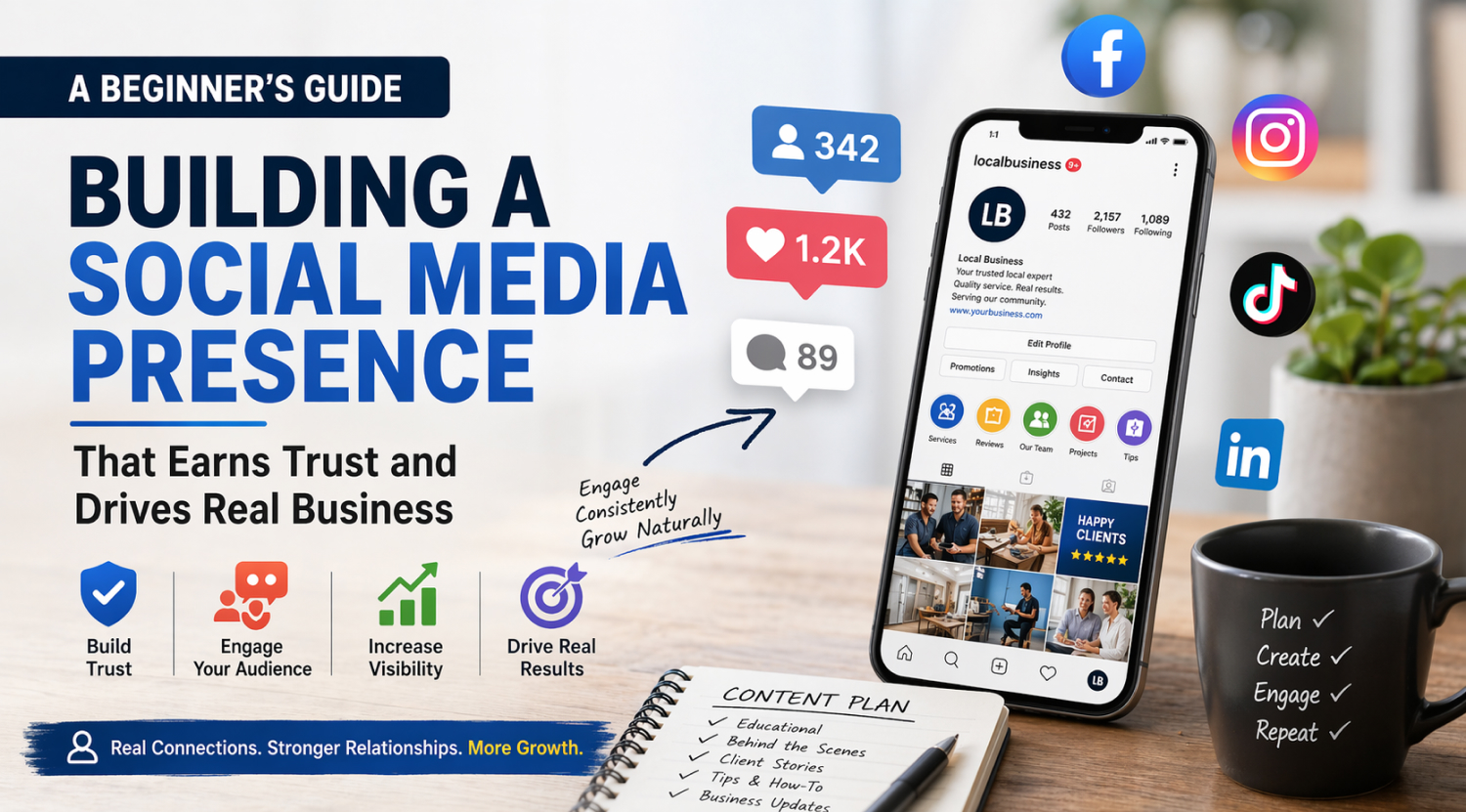
Social media is not optional anymore – even for businesses that get most of their customers through referrals, search, or word of mouth. The reason is simple: people check. Before calling a plumber, booking a dentist, or hiring a lawyer, a growing number of potential customers look up the business on Instagram, Facebook, or TikTok. According to Sprout Social’s 2025 Index, 68% of consumers follow brands on social media to stay informed about products and services, and 46% follow because they enjoy the content.
What they find – or don’t find – shapes their decision. An active social profile with recent posts, real photos, and genuine engagement signals a business that’s alive and well. A dormant profile with nothing posted since 2022 raises questions. No profile at all can feel like the business doesn’t exist.
At Logik Digital, we build social media strategies for local service businesses that integrate with SEO, email marketing, and content clusters to create compounding visibility. This guide covers everything a beginner needs to know: why social media matters, how to pick the right platforms, what to post, how to stay consistent, how to build an engaged following, and how to measure results.
Why Social Media Matters for Your Business
Customers Research You on Social Before Contacting You
Social media has become a credibility checkpoint. A 2025 GWI report found that 48% of consumers aged 25-54 use social media as part of their research process before purchasing a product or hiring a service. They are not looking for ads – they are looking for signals that your business is real, active, and trusted by others.
That means your social presence is not just a marketing channel. It is a trust signal. A profile with real photos, genuine customer interactions, and recent activity tells a potential customer they are making a safe choice. A dead or missing profile creates doubt – even if your actual service is excellent.
“Social media for local businesses isn’t about going viral – it’s about being consistently present when potential customers check. A dormant profile raises more questions than no profile at all,” says Jay Baer, bestselling author of Youtility and a leading digital marketing strategist.
Social Platforms Build Trust Before the First Contact
Social media lets potential customers get to know your business before they ever reach out. They see how you interact with people. They see your work. They see how you handle questions and complaints. They get a sense of your personality and values. By the time they pick up the phone or fill out a contact form, they already feel like they know you – and that familiarity dramatically increases the likelihood that they follow through.
An Inactive Profile Hurts More Than No Profile
This is worth emphasizing: a dormant social media profile is worse than not having one at all. If someone finds your Facebook page and the last post was 18 months ago, they are not thinking “this business doesn’t use social media.” They are thinking, “Is this business still open?” If you are going to be on a platform, commit to keeping it active. If you cannot, remove the profile or, at a minimum, keep your business information and contact details up to date.
Choosing the Right Platforms
You don’t need to be on every platform. In fact, trying to maintain a presence everywhere is one of the fastest paths to burnout and inconsistency. Pick 1-2 platforms where your target audience actually spends time, and do them well.
| Platform | Best For | Content Style | Audience |
|---|---|---|---|
| Community building, local businesses, events | Longer posts, photos, videos, events, groups | Broad audience – strongest with 30–65 age range | |
| Visual businesses, lifestyle, and younger audiences | Photos, Reels (short video), Stories, carousels | 18–44, visually driven | |
| TikTok | Reaching younger audiences, viral discovery | Short-form video (15–90 sec), trending audio | 16–34, discovery-driven |
| B2B, professional services, thought leadership | Articles, professional updates, industry insights | Professionals, decision-makers | |
| YouTube | Long-form education, tutorials, demonstrations | Videos 5–20+ min, Shorts for quick content | All ages – the second largest search engine |
How to Decide
Ask two questions: Where do my customers spend time? And what type of content can I realistically create? A home renovation company with great before-and-after photos is a natural fit for Instagram. A law firm that explains complex topics clearly fits LinkedIn or YouTube. A local restaurant with personality fits TikTok and Instagram.
If you are unsure, start with Facebook (it still has the broadest reach for local businesses) and Instagram (it covers visual storytelling and short-form video through Reels). Add a third platform only after you have built consistency on the first two.
Content Strategy and Planning
The businesses that succeed on social media are not the ones with the biggest budgets or the fanciest cameras. They are the ones who post consistently with a clear plan behind it. A content strategy answers three questions: what are you going to post, why does your audience care, and how often can you realistically sustain it?
Content Types That Work
| Content Type | What It Does / Example |
|---|---|
| Educational | Demonstrates expertise, provides value – “3 signs your roof needs attention before winter” |
| Behind-the-scenes | Humanizes your business, builds connection – team at work, your process, day-in-the-life |
| Client stories / Results | Provides social proof, shows real outcomes – before-and-after, testimonials, case studies |
| Myth-busting | Builds authority, drives engagement through debate – “Stop believing this about [industry topic].” |
| Tips and how-to | Positions you as the helpful expert – quick demos, checklists, short tutorials |
| Business updates | Signals activity, keeps followers informed – new services, team news, hours changes, events |
| Community involvement | Shows you are local and connected – sponsorships, charity work, local events |
The 70-20-10 Content Mix
A useful framework for planning your content: 70% value-driven content (educational, tips, stories, entertainment), 20% shared or community content (industry news, partner features, user-generated content), and 10% promotional (direct offers, service announcements, booking CTAs). This ratio keeps your feed interesting and useful rather than feeling like a constant advertisement.
For a complete social media content calendar with 90 days of post ideas organized by content type and platform, see our dedicated guide: [SUPPORTING POST: Social Media Content Calendar – 90 Days of Post Ideas for Businesses].
Planning Ahead
Create a simple content calendar – even just a spreadsheet with dates, post types, and brief descriptions – so you are never scrambling for ideas at the last minute. Plan 2-4 weeks ahead. Batch your content creation: set aside a few hours once a week or twice a month to create multiple posts at once. This is far more efficient than creating one post at a time, and it protects your consistency during busy weeks.
Scheduling tools like Later, Buffer, Hootsuite, or Meta Business Suite let you create posts in advance and schedule them to publish automatically. This means you can do all your social media work in one sitting and not think about it until the next batch.
Creating Visual Content That Performs
Social media is a visual medium. The quality and authenticity of your photos and videos directly impact how people perceive your business.
Photography and Graphics
You don’t need professional equipment – a modern smartphone with good lighting produces perfectly usable content. What matters more than camera quality is authenticity. Real photos of your team, workspace, work, and customers (with permission) will always outperform stock images or generic graphics.
For graphics, tools like Canva offer free templates designed for social media. Create a simple brand template with your colours, fonts, and logo, then use it consistently. Visual consistency across your posts makes your brand recognizable as people scroll through their feed.
Video Content
Video dominates social media engagement in 2026. Wyzowl’s 2025 State of Video Marketing survey found that 91% of businesses use video as a marketing tool, and 87% of marketers say it directly increased their sales. Short-form video (Reels, TikTok, Shorts) is the highest-performing format across all major platforms.
You don’t need production value. A 30-second clip of you explaining a quick tip, showing a completed project, or answering a common question – shot on your phone, with decent lighting and clear audio – performs better than a polished but impersonal corporate video. Start simple. Speak directly to the camera. Be specific and helpful. That is the formula.
The businesses that win on social media treat it as a trust channel, not a sales channel. Show your work, share your expertise, and let the sales follow the credibility,” notes Ann Handley, Chief Content Officer at MarketingProfs and author of Everybody Writes.
Consistent Branding
Use the same profile photo, colour palette, and general aesthetic across all platforms. When someone sees your post in their feed, they should recognize it as yours before reading the caption. This visual consistency builds brand recognition over time – and brand recognition builds trust.
Platform-Specific Best Practices
Facebook still has the broadest reach for local businesses. Use it for longer-form posts, event promotion, community groups, and customer service. Post 3-5 times per week. Facebook Groups (either your own or local community groups) are particularly powerful for building a local audience. Respond to every comment and message – Facebook tracks response time and shows it publicly on your page.
Instagram rewards consistency, visual quality, and Reels. Post feed content 3-4 times per week, with Stories daily if possible (even a simple behind-the-scenes photo counts). Reels get significantly more reach than static posts – even a simple 15-second tip filmed on your phone can outperform a polished carousel. Use 5-10 relevant hashtags per post (not 30 – the algorithm has shifted) and engage with other local accounts to expand your reach.
TikTok
TikTok’s algorithm is uniquely discovery-driven – even accounts with zero followers can reach thousands of people if the content resonates. Post 3-5 times per week. Use trending audio when it fits your content naturally (don’t force it). Keep videos short (15-60 seconds) and front-load the hook in the first 2 seconds. Educational content (“Things your [professional] wants you to know” or “3 mistakes people make when [topic]”) performs exceptionally well for service businesses.
Adapting Content Across Platforms
You don’t need entirely different content for each platform. A single video can be posted as a Reel on Instagram, a Short on YouTube, and a TikTok. A detailed Facebook post can be summarized into an Instagram carousel. The key is adapting the format and tone to each platform’s norms – not creating everything from scratch.
Building and Maintaining Consistency
Consistency is the single most important factor in social media success – and it’s where most businesses fail. They post enthusiastically for two weeks, get busy with actual work, and go silent for a month. The algorithm notices. The audience notices. And the results disappear.
A Realistic Posting Schedule
Be honest about what you can sustain long-term. Three posts per week, every week, for a year, is infinitely more effective than daily posting for one month followed by silence. Start with the minimum you can commit to – even 2-3 posts per week is enough to build momentum on most platforms – and increase only when it feels sustainable.
Batch Creation and Scheduling
The most efficient approach is to batch-create content: set aside 2-3 hours once a week (or once every two weeks) to create and schedule all your posts in advance. Take multiple photos at once. Film 3-4 short videos in one session. Write captions in batches. Schedule everything using a tool like Later, Buffer, or Meta Business Suite. This protects your consistency even during the busiest weeks.
Repurposing Content
A single piece of content can be repurposed multiple times: a blog post becomes 3-4 social media posts. A client testimonial becomes an Instagram post, a Facebook post, and a Google Business Profile post. An email newsletter highlight becomes a LinkedIn post. A video tip becomes a Reel, a TikTok, and a YouTube Short. AI-powered content tools can help you repurpose even faster – generating caption variations, suggesting hashtags, and reformatting content for different platforms. Stop creating everything from scratch – repurpose strategically.
Community Engagement and Relationship Building
Social media is a two-way conversation, not a broadcast channel. The businesses that see the strongest results are the ones that actively engage with their audience – not just post and disappear.
Respond to Everything
Reply to every comment and direct message, even if it’s just a brief acknowledgment. People who take the time to interact with your content are giving you a gift – their attention. Ignoring them sends a clear signal that you don’t value them. Prompt, genuine responses build loyalty and encourage more engagement, which in turn tells the algorithm to show your content to more people.
Start Conversations
Don’t just post and wait. Ask questions in your captions. Run polls in your Stories. Invite opinions. “What’s the biggest challenge you face with [topic]?” or “Which would you choose: A or B?” gives your audience a reason to engage. The algorithm rewards posts that generate comments and shares – questions and opinion-based prompts drive both.
Collaborate Locally
Partner with complementary local businesses for cross-promotion. A personal trainer and a nutritionist. A realtor and a mortgage broker. A wedding photographer and a florist. Joint content, shared audiences, and mutual recommendations expand your reach to people who are likely interested in your services but haven’t yet discovered you.
Growing Your Following Organically
Follower count isn’t everything – 100 engaged local followers are worth more than 10,000 passive ones who will never buy from you. That said, growing your audience matters because it expands the pool of people who see your content, and the larger that pool, the more opportunities you have to turn attention into business.
Hashtags and Discovery
Hashtags help people who don’t follow you find your content. Use a mix of broad hashtags (#smallbusiness, #homeimprovement) and specific local hashtags (#TorontoPlumber, #MississaugaRealEstate). On Instagram, 5-10 relevant hashtags are the current sweet spot. On TikTok, 3-5 focused hashtags work best. Don’t use irrelevant trending hashtags just for reach – it attracts the wrong audience and confuses the algorithm about who your content is for.
Trending Formats and Audio
On Reels and TikTok, using trending audio or formats can dramatically boost your reach. The algorithm prioritizes content that uses popular sounds and trends. The key is adapting the trend to fit your business – don’t force a dance trend if you’re a law firm, but do jump on an audio trend if you can put a relevant spin on it. Trending content that is also genuinely useful performs best of all.
Cross-Promotion
Promote your social accounts through your other marketing channels. Include social links in your email signature and newsletters. Add social icons to your website. Mention your social accounts on your Google Business Profile. Every touchpoint is an opportunity to grow your social audience with people who already know your business.
Giveaways and Incentives
Contests and giveaways (“Tag a friend who needs this,” “Share this post for a chance to win”) can accelerate follower growth quickly. Just make sure the prize is relevant to your business – giving away a free service consultation attracts potential customers; giving away an iPad attracts everyone. The goal is followers who might actually become clients, not just a bigger number.
Social Media Compliance and Professional Boundaries
Customer Privacy and Consent
Never share a customer’s name, photo, story, or result without explicit written consent. This is true across every industry, but it is especially critical in healthcare (HIPAA), legal (attorney-client privilege), and financial services (client confidentiality). When in doubt, ask permission first. A simple signed release form protects both you and your client.
Professional Disclaimers
If your industry involves advice (medical, legal, financial), make sure your social content includes appropriate disclaimers: “This is general information, not professional advice. Consult a [professional] for your specific situation.” Include this in your bio and periodically in posts that could be interpreted as specific advice. It protects your legal rights and maintains professional standards.
Handling Negative Comments and Crisis Management
Negative comments happen. Don’t delete them (unless they are spam or abusive) – respond calmly and professionally, offer to resolve the issue offline, and move on. Public arguments never end well for businesses. If a genuine crisis occurs (a viral complaint, a misunderstanding, a controversial incident), respond quickly with facts, take accountability where appropriate, and move the conversation to private channels. A thoughtful response to criticism can actually build trust with everyone else watching.
Measuring What’s Working
Social media platforms provide free analytics that tell you what is performing and what isn’t. Use them. Posting without checking the data is guessing.
Key Metrics to Track
| Metric | What It Tells You / What to Watch For |
|---|---|
| Engagement rate | How much your audience interacts with your content. More useful than follower count – high engagement = relevant content. |
| Reach | How many unique people saw your content? Track monthly for growth trends. |
| Website clicks | How many people clicked through to your site? The bridge between social media and actual business results. |
| Saves and shares | How valuable people find your content. High saves = content worth keeping; high shares = worth recommending. |
| Follower growth rate | How fast is your audience growing? Steady growth matters more than spikes. |
| Top performing content | Which posts get the most engagement? Do more of what works; stop doing what doesn’t. |
Tracking Real Business Impact
Social media metrics are useful – and AI-powered analytics tools are making it easier to identify which content drives actual business results, but the metrics that matter most are the ones that connect to revenue: website visits from social, leads generated, bookings made, and customers acquired. Use UTM parameters (tracking codes added to links) to see exactly how much traffic your social posts drive to your website. Google Analytics shows you what that traffic does once it arrives. Social content also builds brand mentions, which strengthen your AI search visibility – AI engines factor in brand presence across platforms when deciding whether to cite your business. Our SEO guide covers Google Analytics setup and conversion tracking in detail.
For a step-by-step guide to setting up UTM tracking, connecting social media to Google Analytics, and measuring actual ROI from your social efforts, see our dedicated guide: [SUPPORTING POST: How to Measure Social Media ROI for Your Business].
Review Monthly, Adjust Quarterly
Check your analytics monthly to spot trends: which content types get the most engagement, which platforms drive the most website traffic, and whether your audience is growing. Every quarter, review the bigger picture: is social media contributing to actual business results? Adjust your strategy based on what the data shows – not what you assume is working.
Common Social Media Mistakes to Avoid
Posting Without a Plan
Random, sporadic posting confuses the algorithm and trains your audience to ignore you. Use a content calendar, batch your creation, and commit to a sustainable schedule. Consistency beats creativity every time.
Making Every Post a Sales Pitch
If every post asks people to buy, book, or call, your audience will tune out. Follow the 70-20-10 rule: 70% value, 20% community, 10% promotion. Earn attention by being useful, then use a fraction of that attention to promote.
Ignoring Comments and Messages
Not responding to comments and DMs signals that you don’t care about your audience. Every unanswered question is a potential customer walking away. Respond to everything, promptly and genuinely.
Posting Identical Content on Every Platform
A Facebook post doesn’t work the same way as an Instagram Reel. A LinkedIn article doesn’t work as a TikTok. Each platform has its own norms and audience expectations. Repurpose your core ideas while adapting the format and tone to each platform.
Chasing Vanity Metrics
Follower count feels important, but it means little if those followers never buy from you. Focus on engagement (are people interacting with your content?), website clicks (are they visiting your site?), and conversions (are they becoming customers?). 500 engaged local followers are more valuable than 10,000 passive ones from across the country.
Advanced Strategies (Once the Basics Are Working)
Paid Social Advertising
Once you have built a consistent organic presence, paid social ads can amplify your reach. Facebook and Instagram ads are particularly effective for local businesses because of their precise geographic and demographic targeting. Start small ($5-$10/day), target your local service area, and test what resonates before scaling. For paid search advertising, our Google Ads guide covers campaign setup, budgeting, and optimization in detail.
For a beginner’s guide to running Facebook and Instagram ads – including targeting, budgeting, ad formats, and optimization – see our dedicated guide: [SUPPORTING POST: Facebook and Instagram Ads for Local Businesses – A Beginner’s Guide].
Integration with Email Marketing
Social media builds your audience. Email marketing converts it. Use social posts to promote your email lead magnet and grow your list. Use email to promote your social content and grow your following. The two channels feed into each other: subscribers who follow you on social see your content more often, and social followers who join your email list receive your messages directly. Together, they create multiple touchpoints that build trust faster than either channel alone.
Influencer and Partner Collaborations
Local micro-influencers (1,000-10,000 followers in your area) can be surprisingly effective and affordable. A local fitness influencer posting about your physiotherapy clinic, or a local food blogger featuring your restaurant, puts your business in front of a targeted, trusting audience. Look for influencers whose audience matches your customer base and whose values align with your brand.
Getting Started: Your First Steps
Social Media Quick-Start Plan
WEEK 1: Choose 1-2 platforms. Set up or refresh your profiles (bio, photos, contact info, links). Follow 20-30 local accounts in your industry and community.
WEEK 2: Create your first 8 posts (enough for 2 weeks of content). Mix educational tips, behind-the-scenes, and one promotional post. Schedule them using a free scheduling tool.
WEEK 3: Engage daily – respond to comments, like and comment on other local accounts, reply to DMs. Film your first short video (30 seconds, one helpful tip, shot on your phone).
WEEK 4: Review your analytics. Which posts got the most engagement? Which got the least? Plan next month’s content calendar based on what worked.
Social media is a long game. The businesses that win are not the ones with the most followers or the flashiest videos – they are the ones that show up consistently, provide genuine value, and treat their audience like real people instead of metrics. Start simple, stay consistent, and let the results build over time.
Frequently Asked Questions
Q: How often should I post on social media?
3-5 times per week on your primary platform is a strong target. If that is not sustainable, 2-3 times per week is enough to maintain visibility and momentum. Consistency matters more than volume – 3 posts per week, every week, beats daily posting for one month followed by silence.
Q: Which social media platform is best for my business?
It depends on your audience and content style. Facebook has the broadest reach for local businesses. Instagram works well for visual businesses. TikTok excels at discovery and reaching younger audiences. LinkedIn is best for B2B and professional services. Start with 1-2 platforms where your customers actually spend time and expand only when you have built consistency.
Q: How do I come up with content ideas?
Start with the questions your customers ask you most often – each one is a potential post. Document your work process for behind-the-scenes content. Share client results (with permission). Bust common myths in your industry. Share quick tips. Your day-to-day expertise is more interesting to potential customers than you think.
Q: Do I need to be on TikTok?
Only if your target audience is there. TikTok skews younger (16-34) and rewards short-form video content. If you serve a younger demographic and can create quick, helpful videos, it is worth testing. If your audience is primarily 45+ professionals, your time is better spent on Facebook and LinkedIn.
Q: Should I buy followers?
No. Purchased followers are fake accounts that will never buy from you, never engage with your content, and actively hurt your engagement rate (which the algorithm uses to decide who sees your posts). Build your following organically with real people who might actually become customers.
Q: How do I measure social media ROI?
Track website clicks from social media (using UTM parameters), leads generated (form submissions and calls from social traffic), and actual customers acquired. Compare the revenue those customers generate against your time and any money spent on tools or ads. If you are not tracking website traffic from social, start there – it is the clearest link between social activity and business results.
Q: What is more important – followers or engagement?
Engagement, without question. 500 followers who regularly like, comment, share, and click through to your website are infinitely more valuable than 10,000 followers who scroll past everything you post. The algorithm rewards engagement, and engaged followers become customers.
Q: How long does it take to see results from social media?
Expect 3-6 months of consistent posting before seeing meaningful business results. You will see engagement and follower growth sooner (within weeks), but converting social media attention into actual leads and customers takes time. The businesses that quit after 60 days because “social media doesn’t work” almost always would have seen results at month 4 or 5.
Q: How do I handle negative comments on social media?
Respond calmly and professionally. Acknowledge the concern, apologize if appropriate, and offer to resolve the issue privately (“We are sorry to hear that. Please DM us your details so we can make this right.”). Never argue publicly, never delete legitimate complaints (only spam or abuse), and never ignore them. Your response is not just for the commenter – it is for every future customer reading it.
Q: Should I use the same content on every platform?
Repurpose the core idea while adapting the format. A detailed Facebook post becomes a shorter Instagram caption with a visual. A long video becomes a 30-second Reel or TikTok highlight. Each platform has different norms – what works on LinkedIn feels out of place on TikTok. Adapting takes less time than creating from scratch, and it performs significantly better than copy-pasting identical content everywhere.
Ready to grow your business? Explore Logik Digital’s social media services or book a strategy call.

Share video
Video URL