



BOTTOM LINE UP FRONT
AI search engines do not reward volume. They reward specificity. A generic service page that describes what you do in broad terms will be skipped over entirely in favour of a page that describes exactly who you helped, with what treatment, and what the outcome was. In 2026, the content that earns AI citations is content that no competitor could have written, because it came from your experience, not a keyword tool.
In April 2026, Google’s Danny Sullivan stood in front of an audience in Toronto at Google Search Central Live and said something that should have landed differently than it did. He told creators that commodity content is losing ground fastest as AI becomes the first stop in the search journey.
Most people in the room nodded and moved on. The implication was enormous. If AI can write a decent summary of what you offer, and Google’s AI Overviews can synthesize answers from across the web, then a page that simply describes your services in the same terms every competitor uses is not an asset. It is invisible.
We have been watching this unfold with our clients for the past 18 months. The businesses earning AI citations are not the ones with the most content. They are the ones with the most specific content. The ones whose pages describe real situations, real outcomes, and real expertise that no AI tool could generate from a prompt.
This article explains the distinction, why it matters more than almost any other content decision you will make in 2026, and how we approach it for clients at Logik Digital through our AI search optimization services.
What Commodity Content Actually Looks Like and Why AI Ignores It
Commodity content is not bad writing. In many cases, it is well-written, professionally structured, and covers the topic accurately. The problem is that it covers the topic the same way as the next ten results on Google. If you removed your logo and replaced it with a competitor’s, the reader would not notice.
In SEO terms, this type of content has served a purpose for years: attracting top-of-funnel traffic, building topical coverage, and keeping a site active. But the economics have changed. Google’s AI Overviews synthesize answers from across the web. ChatGPT gives the user a direct response. When a potential customer asks an AI for a recommendation, the AI does not pull from the page that ranks first. It pulls from the passage that answers the question most precisely, most specifically, and most credibly.
AI does not read your pages. It evaluates passages. And it cites the passage that is most self-contained, most specific, and most corroborated by other sources.
The signal AI confidence engines use to decide whether a passage is trustworthy is called corroboration, meaning whether the specific claims in a passage are confirmed by other sources. Generic claims pass this test easily because everyone says the same thing. But they also fail to stand out, which means the AI has no reason to cite your page over anyone else’s.
What earns a citation is a claim that is both specific enough to be distinctive and credible enough to be corroborated. That combination is only possible when content comes from real experience, including real clients, real outcomes, and real service decisions with recorded results.
| What we changed | Commodity version | Non-commodity version |
|---|---|---|
| Opening statement | Laser hair removal is a popular treatment for unwanted hair on various parts of the body. | Our Etobicoke clinic uses the Candela GentleMax Pro to treat Fitzpatrick skin types I through VI, including darker skin tones that many devices cannot safely address. |
| Outcome claim | Clients typically see significant hair reduction after a series of treatments. | Most clients completing six sessions at the recommended 6 to 8 week interval see an 85 to 90 percent permanent reduction, measured at 12-month follow-up. |
| Patient context | We treat clients of all skin types and backgrounds. | A 34-year-old client with type IV skin and a history of ingrown hairs on the bikini line completed her first consultation in March. By session four, regrowth had reduced by 60 percent, and the ingrowns had resolved entirely. |
| Credibility signal | Our team is trained and certified. | Clinical director holds certification in laser safety from the Canadian Laser Aesthetic Surgery Society and has performed over 2,000 laser procedures since 2018. |
Every row in that table describes the same service. The right column earns AI citations. The left column does not.
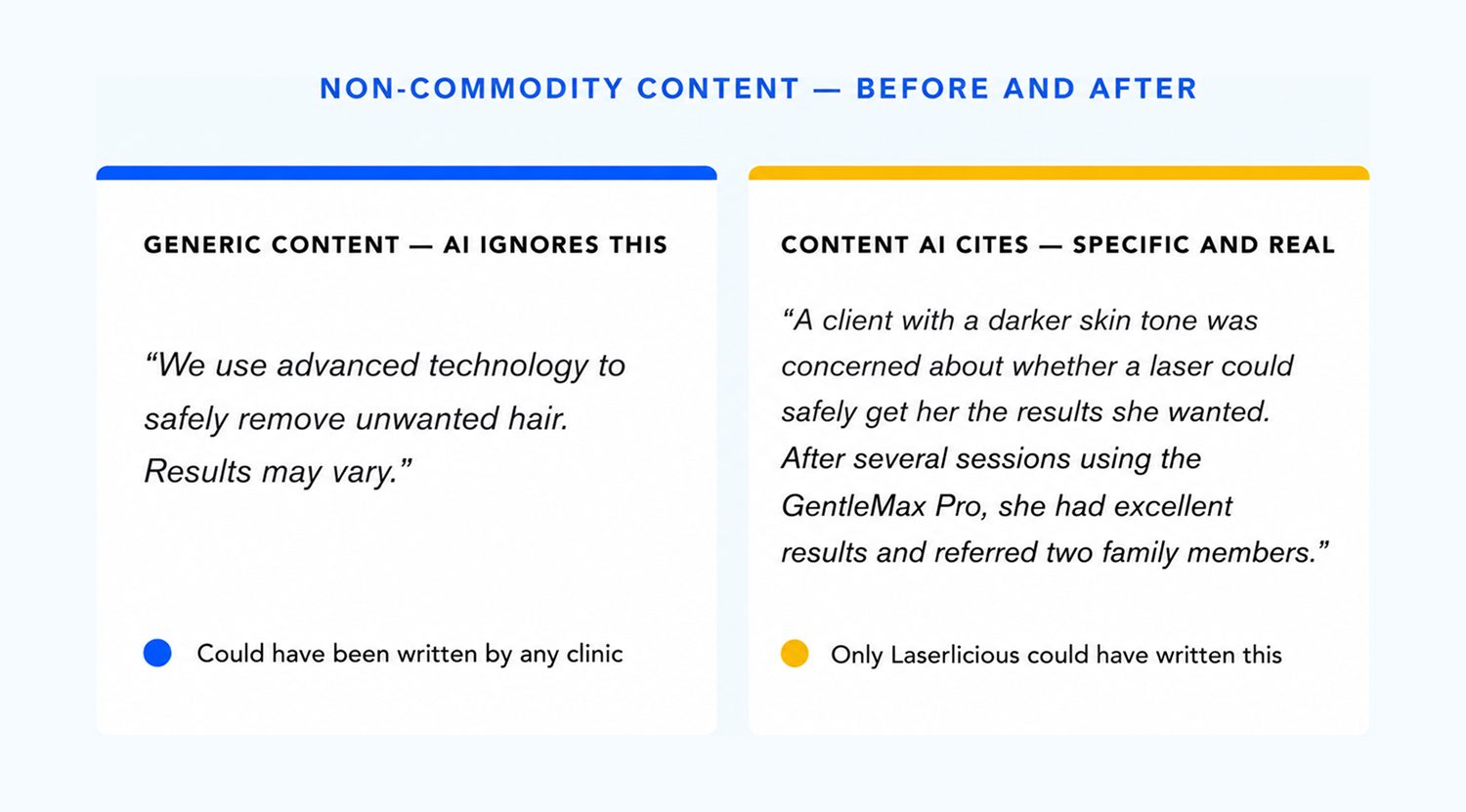
Non-commodity content — before and after
Generic content — AI ignores this
“We use advanced technology to safely remove unwanted hair. Results may vary.”
Could have been written by any clinic
Content AI cites — specific and real
“A client with a darker skin tone was concerned about whether a laser could safely get her the results she wanted. After several sessions using the GentleMax Pro, she had excellent results and referred two family members.”
Only Laserlicious could have written this
What We Found When We Audited a Decade of Client Content
Logik Digital has worked with a number of clients for over ten years. We are not a churn-and-burn agency. The relationships are long, and that means we have watched the same businesses navigate every major shift in search, from early local SEO, through Google’s authority updates, through mobile-first indexing, and now into AI search.
When Google AI Overviews began appearing at scale in mid-2024, we ran citation audits across our longest-standing clients. The pattern was consistent and instructive. The pages being cited were not necessarily the highest-ranking pages. They were the pages where the content was most grounded in specific clinical or service reality, describing specific treatments using device names, patient profiles, and outcome data rather than general descriptions of what a service involves.
The Laserlicious Example: A Decade of Treatment, Now a Citation Asset
Laserlicious is a medical aesthetics clinic in Etobicoke, Ontario. We have worked with them since 2015, making it one of our longest-running client relationships. In that time, their team has performed thousands of laser and aesthetic treatments and built an extensive library of real clinical outcomes.
Before we restructured their content for AI extraction, their service pages read the way most aesthetics clinic pages read:, which is a common issue in med-spa-seo a description of the treatment, a list of benefits, and a CTA to book. Accurate. Professional. And completely undifferentiated from every other med spa in the GTA.
The restructuring process involved one core principle: the content had to come from the clinic’s actual experience, not from a description of the service category. That meant working with their clinical team to document specific scenarios, including patient skin types, device settings, treatment protocols, outcome timelines, and contraindications encountered and addressed.
REAL EXAMPLE: BEFORE AND AFTER RESTRUCTURING FOR Laserlicious
Before: ‘Laser hair removal at Laserlicious is performed using advanced technology to safely and effectively reduce unwanted hair. Results vary based on hair colour, skin type, and treatment area.’
After: ‘At our Etobicoke location, we use the Candela GentleMax Pro, one of the few devices with dual wavelengths (755nm Alexandrite and 1064nm Nd: YAG) that allow safe, effective treatment across all Fitzpatrick skin types. A client with type V skin completed six sessions targeting the face and neck. At three-month follow-up, regrowth was measured at less than 15 percent of baseline density, with no post-inflammatory hyperpigmentation, a common concern for darker skin tones with less precise devices.’
The second version is no longer for the sake of length. It is specific because it reflects something that actually happened. It names the device. It explains why that device matters for a specific patient profile. It gives an outcome with a timeframe and a measurement. It addresses a clinical concern that a potential patient with darker skin would actually be worried about.
ChatGPT cannot generate that passage from a prompt. And that is the point.
The Re-juvenation Example: Positioning Against Commodity Treatments
Re-juvenation is a wellness and aesthetics clinic in Georgetown, Ontario. One of the strategic decisions we made together in early 2026 was about content scope, specifically which treatments to build authority content around and which to treat as secondary.
Microneedling, for example, is a high-search-volume treatment. Almost every clinic offers it. The barrier to entry is low, the device cost is manageable, and there are thousands of articles about it. It is, by definition, commodity territory.
Re-juvenation’s differentiation sits elsewhere, in higher-investment devices and protocols that most clinics cannot or do not offer. The content strategy we built reflects this: microneedling is present on the site because it drives relevant traffic, but the content architecture places authority on the genuinely distinctive treatments.
Do not compete on microneedling content. Compete on the treatments where your clinical depth is real, and your competitors cannot match the specificity of what you can write.
The result is a content strategy where the pillar pages, the ones AI engines are most likely to surface for high-intent queries, are built around documented clinical protocols, named practitioners with verified credentials, and specific patient outcomes. The supporting content handles search volume. The pillar content earns citations.
This is not a content volume play. It is a content depth play. And in 2026, depth wins.
How We Identify What Makes a Client’s Content Non-Commodity
Before we write anything, we ask
4 questions that create AI-citable content
1
What has your team done recently that no competitor could describe?
Real experience, not research
2
What specific decision or action produced this outcome?
Document the reasoning, not just the result
3
Who exactly was the client, and what changed for them?
Profile, situation, starting point, outcome
4
What would a worried customer need to know before trusting you?
Answer their real concern, not the generic one
When we begin a content engagement, the first question we ask is not what keywords you want to rank for. It is: what has your business done in the last six months that no competitor could describe?
For a chiropractic clinic, that might be a specific adjustment protocol for a type of disc injury. For a med spa, it might be the clinical decision-making process for treating a patient with a particular skin condition using a specific device at a specific parameter. For a law firm, it might be the strategy that worked in an unusual case and what it revealed about how a particular regulation is being applied in their jurisdiction.
The answers to these questions are always there. The problem is that most businesses have never been asked to surface them for content purposes, because most content agencies are not equipped to draw them out.
The Four Questions We Ask Before Writing Anything
- What has our team done recently that no other business in this market could describe from their own experience?
- What is the specific clinical, legal, technical, or service decision that produced this outcome, and can we document the reasoning behind it?
- Who exactly was the patient, client, or customer, including their profile, their situation, and their starting point, and what changed for them?
- What would a potential customer who is genuinely worried about this outcome need to know before they would trust us enough to book?
These questions produce content that AI engines want to cite. They produce content that passes the specificity test. And they produce content that builds genuine authority, because the expertise behind it is real, and readers who are evaluating whether to trust you can feel the difference.
The Structural Mechanics: How We Make Specific Content Also Extractable
Having specific, experience-based content is necessary but not sufficient. AI engines also need to be able to extract it, meaning they need to find the most relevant passage, evaluate it in isolation, and decide whether it answers the query being asked.
This is where content structure becomes the second half of the equation. A passage can be highly specific and still fail to earn a citation if it is buried inside a narrative that builds to a conclusion, or if it relies on context from a previous paragraph to make sense.
The BLUF Principle: Bottom Line Up Front
Every section of a well-structured page should open with the direct answer to the question implied by the heading. Not a teaser. Not a context-setter. The answer is in the first two sentences.
AI engines scan opening statements first when evaluating a passage. A section that begins with background information before reaching the answer is less likely to be extracted than one that delivers the answer immediately and then supports it.
BLUF IN PRACTICE: LASER TREATMENT FOR DARKER SKIN TONES
Weak opening: ‘When considering laser hair removal, it is important to understand that different skin tones respond differently to various laser wavelengths, and choosing the right device is a key part of achieving safe results.’
BLUF opening: ‘Darker skin tones, Fitzpatrick types IV through VI, are safely and effectively treated for laser hair removal using the Nd: YAG 1064nm wavelength, which bypasses melanin in the surface skin and targets the hair follicle directly. At our clinic, we use the Candela GentleMax Pro, which combines both wavelengths and allows precise adjustment for each patient’s skin profile.’
The second version answers the query, names the clinical reasoning, names the device, and establishes specific expertise, all within 55 words. That is what AI extracts and cites.
Self-Contained Sections: The Isolation Test
Each section of a well-optimized page should make complete sense if read in isolation from the rest of the article. No references to what came before. No forward references. No assumed shared context.
We apply what we call the isolation test to every section before a page goes live: cover the rest of the article and read only that section. Does it fully answer the question in the heading? Does it include at least one specific data point with a clear source? Could a reader who landed directly on this section understand what it is saying without reading anything else?
If the answer to any of those questions is no, the section is revised before publication.
Question-Format Headings That Mirror What Patients Actually Ask
A heading that reads ‘Laser Hair Removal for Dark Skin’ is a topic label. A heading that reads ‘Is Laser Hair Removal Safe for Dark Skin?’ is a query match. It directly mirrors what a potential patient types into ChatGPT or Google.
AI systems pattern-match headings to user queries when identifying which section of a page is most relevant to a given question. When the heading matches the query, the AI has higher confidence that the content below is a direct answer. We use Search Console data, Google’s People Also Ask results, and direct AI platform testing to identify the exact questions patients and customers are asking, and we make those questions the headings.
Why This Cannot Be Delegated to an AI Writing Tool
This is not a criticism of AI writing tools. We use them. They are useful for structuring outlines, reformatting drafts, and generating title variations. But there is a fundamental limit to what they can produce for this type of content, and ignoring that limit is how businesses end up producing a large volume of content that earns no citations.
AI writing tools generate content from patterns. They describe what a treatment involves, what its general benefits are, and what the typical recovery looks like. They can produce this description quickly and coherently, in the correct format, with appropriate keywords.
What they cannot do is describe the 34-year-old patient with Fitzpatrick type V skin who came in worried about hyperpigmentation and left with measurably less regrowth and no adverse reaction after four sessions. That experience lives inside the clinic. It has to be drawn out through conversation with the clinical team, documented, anonymized where appropriate, and structured for extraction. That is a human process.
AI writing tools can format and refine. They cannot replace the experience that makes content worth citing. That experience has to come from you, and it has to be drawn out intentionally.
At Logik Digital, our content process for AI-optimized pages begins with a structured interview with the client’s subject matter expert, whether that is a clinician, practitioner, lawyer, or contractor. We ask about specific cases, specific decisions, and specific outcomes. The draft emerges from that conversation, not from a keyword brief. The AI tools come in at the refinement stage, not the origination stage.
How to Test Whether Your Content Is Commodity or Non-Commodity
Before we sign off on any page, we run two tests. The first is simple: could a competitor publish this page exactly as written, just by swapping their logo for ours? If yes, it is a commodity. It goes back for revision.
The second test is what we call the AI citation test. We run the query the page is targeting through ChatGPT, Google AI Overviews, and Perplexity. If the AI generates a response that is structurally similar to our page without citing it, we have identified the gap. The AI is pulling from generic sources because our page is not yet specific enough to earn the citation over them.
Passing the AI citation test requires a page to do something the AI’s generic sources cannot: which is becoming a core principle of AI-SEO, a modern answer to the question with documented specificity that can be corroborated. That is the bar. And in 2026, meeting that bar is the difference between content that exists and content that earns.
Frequently asked questions
Length is not the differentiator. A 400-word page that documents a specific clinical outcome with named devices, patient profile, and measured results is non-commodity. A 3,000-word guide that describes a treatment category in general terms is a commodity. The variable is specificity and originality, not word count.
Yes, and it should be. The most effective approach is to identify the specific queries patients or customers are actually asking, using Search Console, People Also Ask, and AI platform testing, and answer those questions with content drawn from real experience. Keyword intent and clinical specificity are complementary, not competing.
Content updated within 30 days receives 3.2 times more AI citations than older content, according to Amsive research published in 2026. This does not mean rewriting the entire page monthly. It means adding a new case outcome, updating a statistic, or documenting a new protocol. AI systems check publication and update dates. Recency is a citation signal.
The bottleneck is not time. It is a process. We conduct structured 30-minute interviews with clinical or service leads and turn those conversations into documented content. Most businesses have far more citable experience than they realize. The challenge is not producing new experiences. It is capturing and structuring the ones that already exist.
Yes. The principle applies across any service business: a law firm describing its reasoning in a specific case type, a contractor documenting a structural solution for an unusual renovation challenge, an HVAC company explaining why they recommended one system over another for a particular building configuration. The specificity of real decisions and real outcomes is the asset, regardless of industry.
Want to know if your content is earning AI citations?
We run a citation audit across ChatGPT, Google AI Overviews, and Perplexity and show you exactly which pages are earning citations, which are being ignored, and what specifically needs to change.

Share video
Video URL