Most businesses treat Google AI as one thing to optimize for. It is two, and the gap between them is wider than the family resemblance suggests. Ahrefs compared the two surfaces across thousands of query pairs in late 2025 and found they cited the same URLs about 13% of the time, while the answers were roughly 86% semantically similar. A business can be the source Google quotes in one and completely absent from the other, for the same question, on the same day. Understanding this distinction, along with how AI search engines cite content, can help you refine your AI SEO strategy for each surface and open new avenues for success. The Simple Version: What Each One Is AI Overviews It is the AI-generated summary box that appears above the traditional blue links on an ordinary search. You do not ask for it. You run a normal search, and Google […]
Content Pruning means reviewing a website or content library and systematically removing, merging, or updating pieces of content that are no longer serving a useful purpose. Some pages get deleted. Some get merged into a stronger version, and some get rewritten. The point is that a smaller, clearer library tends to perform better than a large, muddled one, and that gap has widened since AI started answering questions directly. WHY CONTENT PRUNING MATTERS FOR AI The reason is structural. A traditional SERP had ten links, so a weak page could sit at position eight and cost you nothing. An assistant does not produce a list. AI engines cite content from sources, often one per point, and write an answer from them. It picks a small number of sources, often one per point, and writes an answer from them. When two of your own pages each half-answer the same question, the […]
Getting your business into Google’s AI Overviews is becoming an important part of local SEO. The fundamentals are not completely different from traditional local search. Google still needs to understand who you are, where you operate, what you do, and whether your business is credible. That means having a properly optimized Google Business Profile, consistent business information across the web, strong reviews, useful location and service pages, and enough supporting information from other websites for Google to confidently understand your business. WHAT HAS CHANGED IS HOW GOOGLE USES THAT INFORMATION. Instead of simply deciding which websites should rank first, AI Overviews pull information from different sources and combine it into an answer. That means your business can rank well locally and still not be mentioned in the AI-generated answer above the search results. And increasingly, that AI-generated answer is becoming some of the most valuable real estate on Google. Whitespark […]
Radio-Canada International, the multilingual international service of Canada’s national public broadcaster, featured Hamzah Khadim, co-founder of Toronto-based AI SEO agency Logik Digital, in a report on how the internet is being redesigned for AI rather than human readers. The article, published on August 13th 2026 and syndicated from an original CBC News report by Nora Young, examined what the decline in human web traffic means for businesses and how search has shifted from keywords to conversations. What the Radio-Canada International feature examined The article reported on a fundamental change in how the internet works. Human web traffic is declining across major commercial categories while AI bot traffic is rising. Cloudflare data showed declines in human traffic across retail, software, IT, and finance websites, with some of the hardest-hit categories dropping by up to 40 per cent between June 2025 and April 2026. The article explored what this means for businesses […]
A ghost citation occurs when an AI engine like Google AI Overviews (or ChatGPT, Gemini, Perplexity, etc.) links to a website as a source, but never actually names that brand or website in the visible answer text. The reader sees the AI’s answer, but has no idea which brand or source the information actually came from unless they specifically dig into the source links. In other words, there’s a gap between citation and mentions. A homeowner in Toronto asks ChatGPT why their garage door won’t close. The answer is clear, specific, and correct: check the photo-eye sensors for misalignment, look for an obstruction, test the limit settings. Underneath it sits a small link to a local garage door company’s repair guide. The company wrote every useful sentence in that answer, but its name appears nowhere. That is a ghost citation. THE GHOST CITATION GAP That number is the reason Logik […]
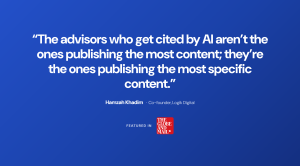
The Globe and Mail featured Hamzah Khadim, co-founder of the Toronto-based AI-SEO agency Logik Digital, in a Globe Advisor feature on how AI search is changing the way professional service businesses get found. The article examined a shift that applies far beyond the financial advisors it profiled: AI platforms do not reward the businesses publishing the most content. They reward the businesses publishing the most specific content. What the Globe and Mail Investigation Revealed The article set out to answer a question that financial advisors, and by extension every professional service business, now face. If AI search creates a different leaderboard for every question, what does it take to appear on any of them? The Globe and Mail identified three areas of focus. THE THREE AREAS OF FOCUS A consistent, machine-readable identity: AI has to tell one professional from thousands, and any inconsistency in how a name, firm, credentials and […]



Share video
Video URL