




Getting your business into Google’s AI Overviews is becoming an important part of local SEO. The fundamentals are not completely different from traditional local search. Google still needs to understand who you are, where you operate, what you do, and whether your business is credible.
That means having a properly optimized Google Business Profile, consistent business information across the web, strong reviews, useful location and service pages, and enough supporting information from other websites for Google to confidently understand your business.
What has changed is how Google uses that information.
Instead of simply deciding which websites should rank first, AI Overviews pull information from different sources and combine it into an answer.
That means your business can rank well locally and still not be mentioned in the AI-generated answer above the search results.
And increasingly, that AI-generated answer is becoming some of the most valuable real estate on Google.
Whitespark found AI Overviews appearing in approximately 68% of the local searches they studied, compared with roughly 39% for the traditional local map pack.
The exact percentage varies significantly depending on the type of search being studied, but the direction is clear: businesses now need to think about being cited and recommended, not just ranked.
At Logik Digital, an AI SEO agency in Toronto, businesses have relied on for years and we approach this in five areas:
- Understand where AI visibility is being lost.
- Build pages Google can easily understand and quote.
- Strengthen the credibility of the business itself.
- Reinforce that information across the web.
- Measure whether visibility is actually improving.
1. Understand What Changed
One of the biggest mistakes businesses make is assuming that AI Overviews simply pull their answers from the websites ranking at the top of Google.
That is not necessarily the case.
Research from BrightEdge has shown surprisingly little overlap between traditional page-one rankings and the sources Google cites in AI Overviews.
In one analysis, only around 17% of AI Overview citations also appeared in Google’s organic top 10.
That is a major shift.
A competitor can rank below you organically and still appear in the AI-generated answer.
Likewise, you could be doing very well in the local map results and still have almost no visibility when somebody asks Google a more detailed question about the best provider, the best treatment, expected pricing, reputation, experience, or suitability.
This is why we treat AI Overviews visibility as an extension of SEO rather than simply another ranking position and it’s a principle that applies directly to AI SEO for local businesses. The objective is to give Google enough reliable information about your business that it is comfortable using you as part of its answer. This also matters because search behaviour is changing.
Pew Research found that when an AI summary appeared, users clicked traditional search results less often than when no AI summary was present.
So even if your traditional rankings stay exactly where they are, the searcher may never get as far as clicking them.
Being mentioned inside the answer therefore becomes increasingly valuable.
2. Build Pages Google Can Actually Use
A good SEO page is not automatically a good page for AI search. In fact, AI search often ignores generic content entirely, no matter how well it’s optimized for traditional rankings. AI systems work particularly well when information is specific, clearly structured and easy to extract. For a local business, that means your pages should contain real information rather than broad marketing statements.
For example, a strong local service page might include:
- the areas you actually serve;
- specific services offered in that location;
- real examples of work completed there;
- locally relevant questions;
- pricing or realistic pricing ranges where appropriate;
- testimonials from customers in that market;
- qualifications, experience and credentials;
- clear business and contact information.
The more specific the page becomes, the easier it is for Google to understand what the business actually does.
Compare these two statements:
We provide high-quality laser hair removal using advanced technology.
Versus:
Our Etobicoke clinic provides laser hair removal using the Candela GentleMax Pro for clients across Etobicoke and west Toronto, including treatments for darker and thicker hair types.
The second statement gives an AI system much more to work with.
It contains a business activity, location, technology, service area, and a specific treatment consideration. That type of factual specificity is much more useful than adding another variation of a keyword.
Answer important questions early
We also recommend answering the main question relatively early on the page. It is the core part of structuring content for AI search engines.
There is some research from other AI platforms suggesting that cited information tends to appear disproportionately near the beginning of content.
That research should not be treated as a confirmed Google AI Overview ranking rule, but the principle makes sense regardless.
If somebody visits a page asking:
How much does Botox cost in Georgetown?
they should not have to read 900 words before getting an answer. Give them a useful answer first. Then explain the details. That is better for the visitor and easier for search engines to interpret.
Do not hide useful information
Pricing is a good example. Many businesses still avoid publishing any pricing because they want every visitor to contact them first. In some industries, that makes sense.
But when people are actively asking Google questions about cost, Google needs somewhere to find that information. You do not necessarily need to publish an exact price.
A range can be much more useful:
Treatment typically costs between $400 and $800 depending on the area treated and number of units required.
Then explain what affects the price. That gives both the customer and the search engine a much better answer than: Contact us for pricing.
3. Give Google Reasons to Trust the Business
The website is only part of the picture.
Google is also trying to determine whether the business itself appears legitimate, established, and consistently represented across the internet.
Start with the Google Business Profile
For local businesses, the Google Business Profile remains extremely important.
The business name, categories, services, hours, address, photographs, reviews, and other information should be complete and accurate. That information should also be consistent with what appears on your website and other major business directories.
If one website calls you:
ABC Medical Aesthetics
another says:
ABC Med Spa Toronto
and another contains an old address or phone number, you are giving search engines conflicting information.
The goal is to make the business as easy as possible to identify as one clear entity.
Reviews matter, but there is no magic number
There is increasing evidence that highly recommended businesses across AI platforms tend to have strong review profiles.
SOCi’s research, for example, found that businesses recommended by several AI systems generally had substantially stronger ratings and review activity than businesses that remained invisible.
It would be a mistake, however, to turn that into a statement such as: You need a 4.3-star rating to appear in AI results. There is no established 4.3-star Google AI Overview threshold.
The more useful conclusion is simpler:
Businesses with strong, recent reviews and accurate profiles give AI systems considerably stronger trust signals than businesses with weak or neglected profiles.
Reviews also contain something businesses often overlook: information. Customers naturally describe treatments, products, staff members, locations, problems, and outcomes. Over time, that gives Google another source of information about what people associate with your business.
4. Build Evidence Beyond Your Own Website
You can tell Google all day that you are the best business in your market. That becomes much more convincing when other websites appear to agree. This is where traditional citation building, digital PR, directories, reviews, social platforms, and third-party mentions become particularly valuable.
Research into how AI search engines decide what to cite consistently shows that AI systems draw heavily from sources businesses do not directly control. That can include::
- Google reviews;
- industry directories;
- local directories;
- news websites;
- Reddit;
- YouTube;
- professional associations;
- social platforms;
- comparison websites;
- other authoritative industry resources.
This does not mean creating hundreds of low-quality directory listings.
It means making sure your business is represented accurately on the places that actually matter in your market. A lawyer, medspa, garage door company, and physiotherapy clinic should not all have exactly the same citation strategy. The relevant sources depend on the industry.
Fresh information helps too
AI search is also putting more pressure on businesses to keep their information current.
An excellent article written three years ago may still rank. But if another business has updated information, current pricing, recent examples, new photographs, and fresh reviews, it may give the AI system more confidence that the information reflects the business today.
This is one reason we increasingly treat important service and location pages as living assets rather than pages that are written once and forgotten.
A Real Example: Laserlicious in Etobicoke
We have seen this shift firsthand with our clients. Laserlicious is a laser hair removal clinic in Etobicoke that Logik Digital has worked with for many years.
Historically, our focus was heavily centred around traditional Google visibility: rankings, local search visibility, and the Google Business Profile. We are now applying many of those same fundamentals to AI search. When people ask AI systems for recommendations around laser hair removal in Etobicoke, Laserlicious is increasingly being identified as one of the leading businesses in the market.
The clinic has built a very strong underlying footprint:a highly established local presence;
- a 4.8-star review profile with more than 600 reviews;
- detailed treatment information;
- strong local relevance;
- clear information about the technology used;
- substantial third-party validation.
What is particularly interesting is the level of detail AI systems can now surface.
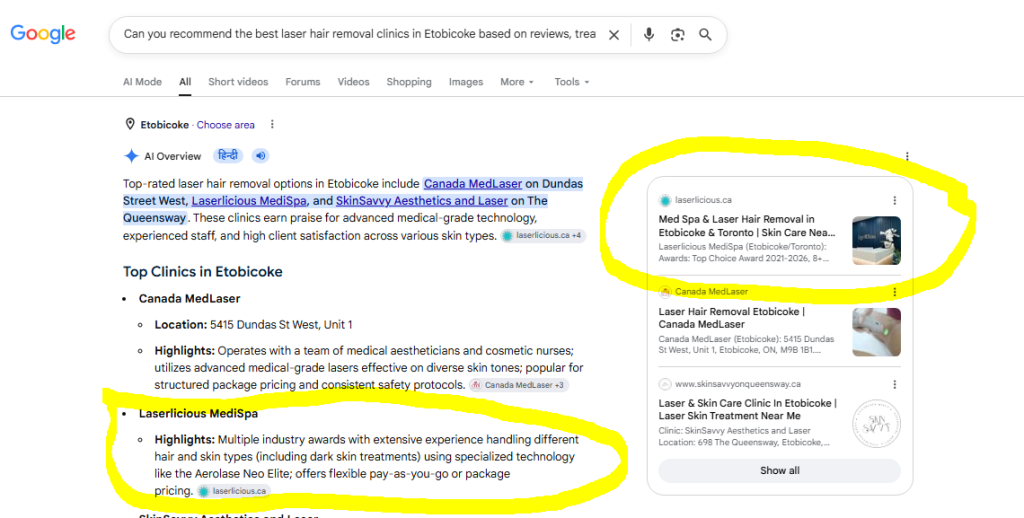
For example, recommendations may reference Laserlicious’ experience treating darker or thicker hair types rather than simply listing the business name.
That is exactly where we believe AI search is heading.
Businesses will not just be ranked. They will increasingly be described, compared, and recommended. And the information used to form that recommendation will come from everything the search engine can verify about the business.
5. Measure AI Visibility Properly
This is still one of the more difficult parts of AI SEO. Traditional SEO gives us relatively mature reporting. We can monitor rankings, impressions, clicks, conversions, and Google Business Profile activity. AI visibility is less straightforward.
Google has begun introducing more reporting around its generative search experiences, and Search Console is gradually providing greater visibility into impressions generated through AI features.
But businesses should be careful about interpreting this data.
AI Overviews and Google’s AI Mode are not the same thing, and Google does not yet give marketers every piece of information they would ideally want. So we use several measurements together.
For local clients, this can include:
- visibility across important AI queries;
- frequency of business mentions;
- which competitors are being recommended;
- which pages or external sources appear to influence the answer;
- AI referral traffic;
- consultations or enquiries associated with AI platforms;
- traditional Search Console performance.
We also manually test important commercial searches. If you are a medspa, for example, we might monitor searches such as:
- best Botox clinic in Georgetown;
- reputable medspa in Georgetown;
- Botox for forehead lines Georgetown;
- how much does Botox cost in Georgetown;
- best clinic for lip filler near Georgetown.
The objective is not simply to ask:
Are we ranking?
We also want to know:
When Google or another AI system answers the question, does it know who this business is, and does it have enough confidence to recommend it?
AI SEO Does Not Replace Traditional SEO
There is a tendency in digital marketing to declare that every new technology has killed whatever came before it. That is not what is happening here. AI search still depends heavily on the same foundation we have been building through SEO for years.
- A strong website matters.
- Google Business Profile optimization matters.
- Reviews matter.
- Content matters.
- Authority matters.
- Links and citations matter.
- Technical SEO matters.
What has changed is the way those signals are being used. Traditional search primarily decides what should rank.
AI systems increasingly have to decide what information they trust enough to use in an answer. Those are related problems, but they are not identical. For a fuller breakdown of how these pieces fit together, see our AI SEO guide for 2026.
The businesses that understand that distinction early have an opportunity. Not because there is some secret AI optimization trick. There isn’t. The advantage comes from building a much clearer and more credible digital footprint than the businesses around you.
What We Recommend Local Businesses Focus on Now
If we were starting with a local business today, we would concentrate on the following before worrying about complicated AI tactics.
First, make sure Google can clearly understand the business. That means an accurate Google Business Profile, consistent information across the web, and a website that clearly explains the business, services, and locations.
Second, strengthen the information on the website. Replace vague marketing content with genuine expertise, useful answers, real examples, pricing information where appropriate, credentials, and locally relevant detail.
Third, build a strong review profile. Not because there is some magic star-rating threshold, but because reviews are one of the strongest independent signals that a real business is established and trusted by its customers.
Fourth, make sure credible third-party sources support what you are saying about yourself. And finally, measure what happens.
- Search your important queries.
- Look at who Google recommends.
- Look at which competitors appear repeatedly.
Then work backwards and understand why.
The Opportunity Right Now
AI Overviews are still developing quickly. Google is changing how they work, marketers are learning how to measure them, and businesses are only beginning to understand what this means for local visibility. That makes this an interesting period. There is still an opportunity for businesses to build a stronger AI presence before their competitors take it seriously. But we would not approach that by abandoning traditional SEO and chasing every new theory about GEO or AI optimization.
We would do the opposite.
- Build a very strong local search foundation.
- Make the information considerably better.
- Make the business easier to verify.
- Build genuine third-party authority.
And structure the website so both people and machines can quickly understand why the business deserves to be recommended. That is increasingly what good SEO looks like. At Logik Digital, we build the work into the broader SEO strategy rather than treating AI visibility as an isolated marketing channel. Connect with Logik Digital to find out how your business currently appears across AI search.
Frequently Asked Questions
1. Do AI Overviews replace the Google map pack?
No. The map pack and AI Overviews can both appear depending on the search. Straightforward searches such as “dentist near me” or “garage door repair Etobicoke” may still heavily favour local map results. More detailed questions such as “what is the best type of laser hair removal for darker skin in Etobicoke?” are much more likely to generate an AI-style answer. Local businesses therefore need visibility in both.
2. Why can a competitor appear in an AI Overview even if I outrank them?
Because traditional rankings and AI citations are not the same thing. An AI system may find information on your competitor’s website, reviews, or third-party sources that better answers the particular question being asked. This is why detailed, specific, and well-supported information matters.
3. How can I tell whether my business appears in AI Overviews?
Search Console is beginning to provide more information around generative search visibility, although reporting is still developing. We recommend combining Search Console data with manual query monitoring, AI referral traffic, and regular competitive testing.
4. Does my Google Business Profile affect AI visibility?
For a local business, absolutely. It is one of Google’s clearest sources of structured information about your company. Make sure your categories, services, hours, business information, photographs, and reviews are complete and current.
5. How many reviews do I need?
There is no universal number. What matters more is having a strong overall reputation, recent reviews, consistent review activity, and enough feedback for Google and potential customers to understand that the business is established. A business with hundreds of genuine recent reviews obviously presents a stronger trust signal than a comparable business with twelve.
Want to Know How Visible Your Business Is in AI Search?
Logik Digital provides AI visibility audits across Google AI Overviews, Google AI Mode, and other major AI search experiences. We identify where your business is already appearing, where competitors are being recommended instead, and what is likely contributing to that difference.

Share video
Video URL